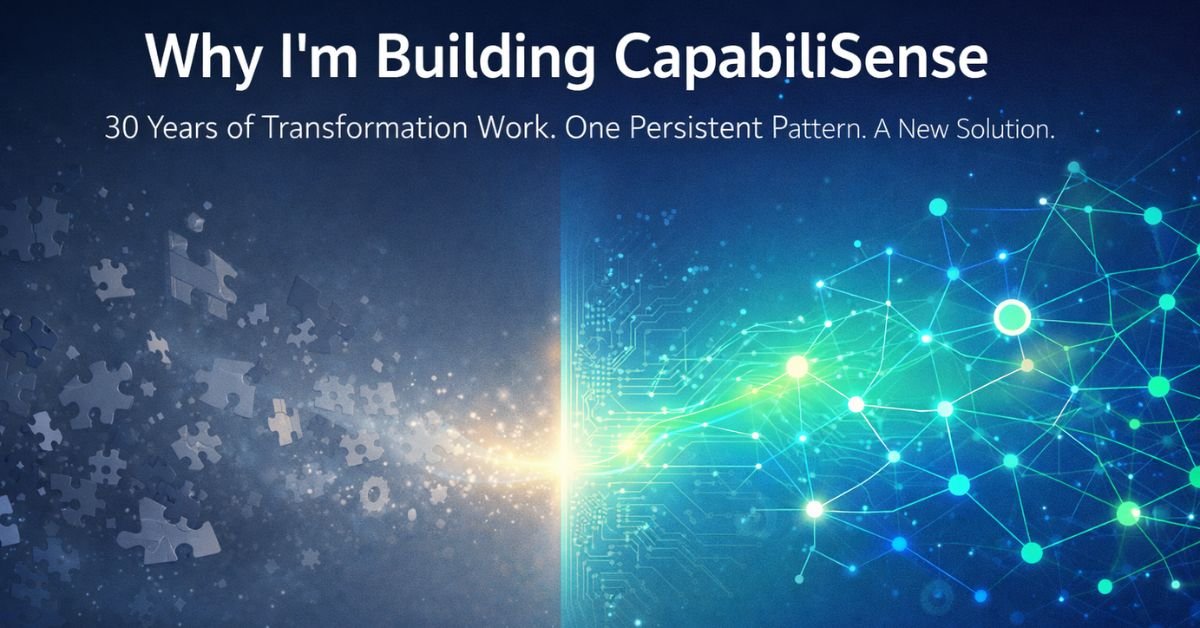
For thirty years, I’ve watched organizations pour billions into digital transformations, only to see 70-95% of these initiatives stumble or fail entirely. Early in my career, I believed the answer lay in better technology, clearer frameworks, or more robust methodologies. I was wrong. The real blocker isn’t technical—it’s profoundly human. After decades of working with enterprises from AWS to Airbus, I’ve recognized a pattern so consistent it demanded a new solution. That solution is CapabiliSense: an AI-driven platform that makes organizational capabilities visible, traceable, and actionable—bridging the gap between grand strategy and daily execution.
The Relentless Pattern: Why Transformations Keep Failing
It’s (Almost) Never the Technology
Every post-mortem tells the same story. Leadership blames resistance to change. Teams cite poor communication. Consultants point to misalignment between departments. The technology itself? Usually works fine. The cloud migration succeeds technically. The AI models perform as expected. The new platform launches on schedule.
Yet the transformation fails.
The breakdown happens in translation. A leadership team announces an ambitious AI strategy or cloud-first mandate. Middle managers nod along in the all-hands meeting. But walk into any department three months later and ask: “How does this grand strategy affect my daily work?” You’ll get blank stares, conflicting interpretations, or well-intentioned guesses that miss the mark entirely.
The Crippling “Capability Fog”
I call this phenomenon capability fog—the organizational inability to honestly assess what you can actually do versus what you think you can do. It’s not malicious. It’s structural.
Organizations systematically overestimate their current capabilities while underestimating the contextual factors that determine success: existing political dynamics, cultural readiness, tooling maturity, and the intricate web of dependencies between teams. A company announces they’re “data-driven” because they have a data warehouse, ignoring that their data governance is at beginner level, their analytics literacy is patchy, and their decision-making culture still defaults to gut instinct.
According to recent research on transformation success rates, unclear capability readiness consistently ranks among the top barriers to execution. Leaders can’t see the gap between their strategic ambitions and their organization’s actual capacity to deliver. Without visibility, there’s no honest conversation. Without honesty, there’s no trust. Without trust, transformations drift into the familiar pattern of expensive failure.
From AWS Frameworks to a Living Platform: My Journey to CapabiliSense
Lessons from Scaling Change at AWS
My conviction that this problem could be solved differently emerged from hands-on work building transformation frameworks at AWS. I contributed to the Cloud Adoption Framework and the Cloud Maturity Assessment, tools designed to help enterprises navigate their cloud journey with clarity and structure.
These frameworks worked—to a point. They gave organizations a shared vocabulary. They broke down overwhelming change into digestible phases. They highlighted dependencies and required capabilities.
But they had limits. They were delivered as static PDFs or spreadsheets. Once created, they immediately began to drift from reality as organizations evolved, priorities shifted, and new challenges emerged. Tailoring them required significant manual effort. Keeping them current was nearly impossible. And critically, they couldn’t automatically translate high-level strategic ambitions into the specific capability gaps that teams needed to address.
The Question That Became a Mission
There wasn’t a single “aha” moment. Instead, it was the weight of recurring pattern recognition. Project after project, client after client, I saw capable people with good intentions trapped in the same failure mode. They had strategy decks. They had roadmaps. They had project plans. What they didn’t have was a living, traceable understanding of their organizational capabilities—one that could connect the dots between “we need to become AI-first” and “here’s exactly where we’re not ready, and here’s what needs to change.”
The pivotal question crystallized during a particularly frustrating engagement: “Why can’t we automate this translation through an intelligent platform?”
Why couldn’t a system ingest all the artifacts an organization already produces—strategy documents, architecture diagrams, project reports, team assessments—and automatically build a dynamic, queryable map of capabilities? Why couldn’t it trace the connections between strategic goals and the specific, current organizational readiness to achieve them? Why couldn’t it provide the honest, shared view that transforms defensive finger-pointing into collaborative problem-solving?
That question became my mission. That mission became CapabiliSense.
What CapabiliSense Actually Is: Your AI-Powered Capability Compass
More Than a Tool: A New Lens on Your Organization
CapabiliSense isn’t another task management system logging who’s doing what. It’s not another dashboard displaying lagging KPIs. It’s a capability intelligence platform—a fundamentally different lens for understanding your organization’s readiness to execute on strategic change.
Think of it as a GPS for business transformation. Just as GPS doesn’t move your car but shows you exactly where you are, the optimal route, and real-time obstacles, CapabiliSense doesn’t execute your transformation—it gives you continuous, honest visibility into your capability landscape so you can navigate change with confidence instead of hope.
How It Works: From Documents to Dynamic Insight
The platform ingests the information your organization already creates: strategic plans, project documentation, architecture blueprints, skills assessments, process maps, and team feedback. Using AI, it constructs a traceable capability map that shows:
- What capabilities you currently have and at what maturity level
- How these capabilities connect to each other and to your strategic objectives
- Where critical gaps exist between ambition and readiness
- What dependencies must be addressed before certain initiatives can succeed
This isn’t based on theoretical frameworks imposed from outside. It’s derived from your actual organizational reality, updated continuously as new information flows in.
Core Principles: Traceability, Honesty, Actionability
Traceability means every insight connects back to source documents and real evidence. You’re not getting consultant opinions—you’re seeing patterns extracted from your own data.
Honesty means the platform surfaces uncomfortable truths. If your data governance capability is at beginner level despite your advanced AI ambitions, the map shows that clearly. This creates the foundation for real conversation.
Actionability means the platform doesn’t just describe problems—it highlights dependencies and sequences. It shows what needs to improve first before other capabilities can mature.
What This Looks Like in Practice
Consider a retail company planning an AI-driven supply chain overhaul. Leadership is excited. The technology partner is ready. The budget is approved. They begin the implementation.
Three months in, the project is struggling. Teams are confused. Data isn’t flowing properly. Decisions are delayed. The usual blame cycle begins.
With CapabiliSense, this scenario plays out differently. Before the launch, the capability map reveals that while the company has strong logistics operations and decent data infrastructure, their data governance capability is at beginner level. There are no clear data ownership policies. Quality standards are inconsistent. Privacy compliance is reactive rather than systematic.
This isn’t speculation—it’s traceable to specific documents, team assessments, and system audits already in the organization. The map shows that advanced AI analytics depends on mature data governance. The strategic path becomes clear: address the governance gap first, then layer in AI capabilities. The company pivots, invests in governance foundations, and when they return to the AI implementation six months later, they succeed because the underlying capability is ready.
This is the shift from capability fog to capability clarity.
The Vision: Fostering Clarity, Trust, and Future-Proof Growth
Ending the Strategy-Reality Disconnect
The most insidious aspect of transformation failure is the breakdown of trust. Leadership feels let down by teams who “resist change.” Teams feel abandoned by leadership who announce visions without understanding ground-level reality. Consultants become scapegoats when promised outcomes don’t materialize.
A shared, honest capability map changes this dynamic fundamentally. When everyone—executives, managers, team members, and external partners—can see the same picture of organizational readiness, conversations shift from defensive to collaborative. “Why aren’t you moving faster?” becomes “We see the gap now—how do we close it together?”
This shared language creates psychological safety. People can be honest about limitations without fear of blame. Organizations can make strategic choices—postponing certain initiatives, sequencing others differently, or investing in foundational capabilities—with confidence rather than politics driving the decision.
Building an Adaptive Organization
The future isn’t static. The capabilities your organization needs will continue to evolve as technology, markets, and competitive dynamics shift. The goal isn’t to reach some final “mature” state—it’s to build learning agility and collaborative intelligence as permanent organizational characteristics.
CapabiliSense is designed for continuous adaptation. As new strategic priorities emerge, the platform helps you understand capability implications immediately. As teams develop new skills, the map reflects that growth. As external dependencies change, the connections update.
This creates organizational resilience—the capacity to navigate ongoing change without the trauma of repeated transformation failures. It’s the difference between a company that lurches from crisis to crisis and one that evolves fluidly because it can sense and respond to its own capability landscape in real time.
Why I’m Building in Public: The CapabiliSense Medium
Transparency Over Hype
I’m documenting this startup journey publicly through the CapabiliSense Medium—not because every detail matters to everyone, but because transparency is core to the mission itself. If the platform is about fostering honest organizational self-awareness, I should demonstrate that same honesty about the process of building it.
You’ll find posts about product development wins and painful pivots. Reflections on customer discovery conversations that confirmed assumptions and ones that shattered them. Deep dives into specific capability patterns that emerged from research. Explorations of how AI technology itself is creating new capability requirements that most organizations aren’t preparing for.
This isn’t performative vulnerability. It’s staying accountable to the mission and creating a learning ecosystem around the platform itself.
Join the Conversation
CapabiliSense is for leaders navigating complex transformations, consultants seeking better tools to serve clients, program managers trapped between strategy and execution, and change agents who know there’s a better way but lack the right instruments.
If you’re wrestling with the gap between organizational ambition and capability reality, if you’re tired of watching well-intentioned initiatives fail for the same predictable reasons, or if you’re simply curious about how capability intelligence could reshape how we think about change—I invite you to engage.
The Medium will evolve with case studies, capability playbooks, interviews with transformation practitioners, and ongoing reflections on the intersection of human organizations and AI technology. Follow along. Challenge assumptions. Share your own patterns and experiences.
Because ultimately, this isn’t just about building a platform. It’s about changing how organizations understand themselves—replacing fog with clarity, hope with confidence, and repeated failure with sustainable transformation.
Frequently Asked Questions
What does “CapabiliSense” mean?
The name combines “capability” and “sense,” representing the platform’s core function: to sense, map, and intelligently develop organizational capabilities. It’s about making the invisible visible and the abstract actionable.
How is CapabiliSense different from change management consulting or maturity assessments?
Unlike static assessments delivered as point-in-time reports or advisory projects that provide recommendations without ongoing visibility, CapabiliSense is a continuous, AI-driven platform. It creates a living capability map derived from your actual documents and workflows, offering real-time traceability and actionable focus that evolves with your organization.
Who is CapabiliSense for?
Primarily for leaders, program managers, and consultants navigating digital, AI, or cloud transformations in mid-to-large organizations. Anyone who needs clarity on execution readiness rather than just strategic vision will find value in capability intelligence.
What is the “CapabiliSense Medium”?
It’s the public blog and content hub where I document the startup’s journey, share lessons on capability intelligence, and foster a community around human-centric transformation. It’s where transparency meets insight.
What’s next for CapabiliSense?
We’re currently developing our MVP with early partners, testing the platform with organizations facing real transformation challenges. Follow the Medium blog for updates on pilot use cases, product development milestones, and deep dives into transformation patterns we’re discovering.
Can I get involved or try CapabiliSense?
If you’re interested in being an early partner, exploring how capability intelligence could serve your organization, or simply want to learn more about the mission, reach out through the contact form or join the conversation on Medium. We’re building this with practitioners, not in isolation.
This platform exists because transformation doesn’t have to fail. With the right visibility, honest conversations, and intelligent guidance, organizations can bridge the gap between strategy and reality. That bridge is capability intelligence. That future is what I’m building toward.

Jesse Zanger is the managing editor of aldalive.com and is based in New York City. He earned a degree in Philosophy from Hamilton College in 1998. Jesse has spent his entire professional career in New York, reporting on both local and national news for MacNeil/Lehrer Productions, Spectrum News NY1, Fox News, and 5ebackgrounds.com. During his time at local News Channel, he was part of the team that helped introduce the on-screen news crawl shortly after 9/11. As a member of the leadership team at 5ebackgrounds.com, the site has received notable industry honors, including a New York State Broadcasters Association Award (2019) and a Regional Edward R. Murrow Award (2017).