If I told you the single most expensive, most impactful document in your company is also the one most likely to be ignored, outdated, and legally dangerous, would you know what I’m talking about?
Every week, I see the same patterns: managers making judgment calls in isolation, promotions that feel arbitrary to those passed over, HR teams constantly firefighting complaints and lawsuits, and employees navigating a workplace that feels fundamentally unfair. The culprit? A document that sits in new hire folders gathering digital dust while creating liability exposure that could cost millions.
After a decade of auditing, rewriting, and yes, litigating around these documents, I can tell you the problem isn’t having a Human Resources Workplace Policy—it’s having a bad one. This isn’t another generic HR listicle telling you to “set clear expectations.” This is a strategic deep dive into theHRWP: what it must be, where everyone goes wrong, and exactly how to build one that drives performance instead of paralyzing it.
What is an HRWP? (Beyond the Basic Definition)
Most people will tell you an HRWP is simply your employee handbook or company policy manual—a collection of workplace rules and HR compliance guidelines. That definition isn’t wrong, but it’s dangerously incomplete.
The Brutal Truth: It’s Not a Handbook, It’s a Contract (And a Shield)
Here’s what keeps employment lawyers up at night: in many jurisdictions, your HRWP creates enforceable contractual obligations whether you intended it to or not. That casual phrase “we typically provide” can become “we must provide” in front of the right judge.
I’ve watched a supposedly at-will employment relationship transform into a for-cause-only termination situation because the handbook stated employees would receive “progressive discipline.” The company thought they were being nice by outlining a fair process. The court saw a binding commitment.
The enforceability varies dramatically by jurisdiction. Some states interpret handbooks as creating implied contracts. Others require explicit disclaimers that the handbook doesn’t constitute a contract. Understanding this legal reality in your specific location isn’t optional—it’s the foundation of an effective HRWP.
But here’s the other side: when properly crafted, your HRWP becomes your shield. It protects you from discrimination claims when you can point to consistently applied policies. It defends against wrongful termination suits when you’ve documented clear violations of known rules. The same document that creates liability when done poorly becomes your primary defense when done right.
The Two Faces of Every HRWP: Compliance vs. Culture
Most companies only see one face of their HRWP: compliance. They pack it with legally required notices about equal employment opportunity, family and medical leave, harassment reporting procedures, and workplace safety. Check the boxes, avoid the fines, move on.
This is thinking small.
The real strategic value of an HRWP lies in codifying culture. When you articulate not just what’s prohibited but what’s celebrated, not just how to report problems but how to drive innovation, not just the consequences of failure but the pathways to growth—that’s when policy becomes culture infrastructure.
Consider flexibility. A compliance-focused HRWP says: “Remote work requires manager approval and must be requested 48 hours in advance.” A culture-focused HRWP says: “We trust our teams to work where they’re most effective. Managers and teams should collaborate on arrangements that balance individual productivity with team cohesion and customer needs.”
Same topic. Completely different organizations.
Your HRWP should answer: What do we actually value here? How do we want people to make decisions when we’re not watching? What’s the character of this place?
The Stakeholder Map: Who Really Cares About Your HRWP?
Every stakeholder approaches your HRWP with different needs, and these needs often conflict:
Legal counsel wants maximum protection, detailed documentation of every contingency, carefully hedged language, and prominent disclaimers. They’re optimizing for defense in litigation.
Leadership wants inspiration, alignment with strategic goals, something that attracts top talent, and preferably something short enough that they don’t need to read it. They’re optimizing for culture and competitiveness.
Managers want clarity, practical guidance for everyday situations, backup when making tough calls, and ideally something that makes their jobs easier rather than harder. They’re optimizing for operational efficiency.
Employees want fairness, transparency about how decisions get made, protection from arbitrary treatment, and honestly, most just want to know if they can work from home on Fridays. They’re optimizing for psychological safety and autonomy.
Candidates want signals about culture, confirmation this isn’t a toxic workplace, evidence of professionalism, and insight into growth opportunities. They’re optimizing for fit assessment.
A mediocre HRWP picks one stakeholder and ignores the rest. An exceptional one finds the synthesis point where legal protection, cultural aspiration, operational clarity, employee trust, and external brand all align. That’s the challenge.
The 5 Critical Components Most Companies Completely Miss
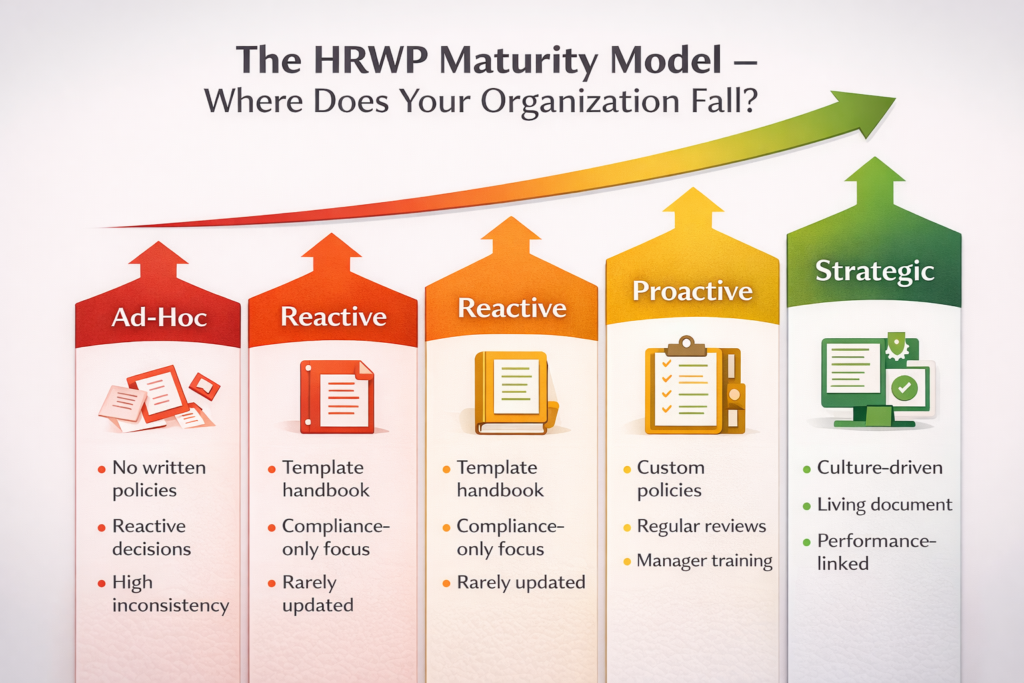
Generic templates cover the basics: vacation accrual, dress codes, anti-harassment policies. But the documents that actually move the needle include components most organizations overlook entirely.
The “How We Work” Code: Remote/Hybrid Principles, Not Just Rules
Post-pandemic, this is where most HRWPs reveal themselves as hopelessly outdated. They either ignore remote work entirely or add a hastily written addendum saying “remote work available at manager discretion, subject to approval.”
That’s not a policy. That’s an abdication.
A sophisticated HRWP addresses the operating model: How do we make decisions asynchronously? What’s our approach to time zones when teams span continents? When do we privilege synchronous collaboration versus deep focus time? What does “presence” mean when bodies in chairs is no longer the metric?
Instead of “Employees must request approval for remote work,” try: “We design roles and teams to be location-flexible by default. Where physical presence creates significant value—such as hands-on technical work, customer-facing roles, or team-building moments—we’re explicit about those requirements. Teams establish their own collaboration rhythms within these parameters.”
This shifts the conversation from permission-seeking to principle-guided autonomy. It acknowledges complexity rather than pretending one-size-fits-all rules work.
The Performance & Growth Engine: Linking Policy to Promotion Paths
Here’s a test: Pull up your promotion policy. Now pull up your performance management system. Do they reference each other? Do they use the same language? Do the criteria match?
In most organizations, the answer is no. Performance reviews talk about competencies and values. Promotion policies talk about time in role and manager recommendation. The two systems exist in parallel universes.
Your HRWP should make the connection explicit: “Promotion decisions reflect demonstrated capability at the next level, verified through our performance assessment framework. Specifically, candidates must show [specific competencies] through [specific evidence types] over [specific time period]. Compensation adjustments accompany role changes according to our published band structure.”
This does something powerful: it tells people exactly what’s required to advance, removes the mystery, and dramatically reduces claims of favoritism. When someone doesn’t get promoted, you can point to specific, documented, policy-defined gaps.
The Digital Conduct Annex: AI, Social Media, and Data Ethics in 2024
I review dozens of HRWPs every year. Maybe one in twenty addresses artificial intelligence usage. Even fewer tackle the ethics of data handling beyond basic confidentiality clauses. Almost none have updated their social media policies since 2015.
This is a massive vulnerability.
Your HRWP needs clear, enforceable, current guidance on:
AI Tool Usage: “Employees may use AI tools to enhance productivity but remain accountable for all work product accuracy, originality, and compliance. Confidential company information, customer data, and proprietary processes may not be input into external AI systems without Security team approval.”
Social Media Conduct: Be very careful here—the National Labor Relations Act protects employees’ rights to discuss working conditions, even critically. Your policy cannot prohibit what the law allows. Instead: “We respect employees’ right to personal expression. We ask that personal accounts not claim to speak for the company and that confidential information remains protected as outlined in your employment agreement.”
Data Ethics: “In handling customer, employee, or company data, apply the principle of minimum necessary access. If your role doesn’t require specific information to accomplish your work, don’t access it. When in doubt, ask.”
These aren’t nice-to-haves. These are the frontlines of your next lawsuit or PR crisis.
The Crisis Playbook: Embedded Protocols for Incidents
Most HRWPs have a harassment policy. It usually says “report to HR” and lists some definitions. That’s not a crisis protocol.
When something goes wrong—harassment, discrimination, violence, a major safety incident—the first 24 hours determine everything. Who gets notified? In what order? What gets documented? Who talks to the affected parties? What’s the communication plan?
Build this into your HRWP as a clear flowchart: “Upon learning of [incident type], immediately notify [specific role]. Within 2 hours, [specific actions]. Within 24 hours, [specific actions]. Throughout, maintain [specific documentation standards].”
In a mediation I oversaw, the conflict stemmed entirely from unclear response protocols. An employee reported harassment to their manager. The manager thought HR would follow up. HR thought the manager was handling it. Two weeks passed. By the time anyone acted, the situation had escalated catastrophically and the company faced both a hostile work environment claim and a retaliation claim.
Clear crisis protocols in your HRWP prevent this chaos.
The “Values in Action” Statements: Turning Platitudes into Processes
Every company claims to value things: integrity, innovation, transparency, collaboration. These words mean nothing unless your HRWP translates them into observable behaviors and processes.
“We value transparency” becomes: “All promotion decisions include a feedback session where the candidate receives skill-based rationale for the outcome, documented in writing. Employees have the right to understand what specific capabilities they need to develop for future advancement.”
“We value innovation” becomes: “Employees at all levels are encouraged to propose process improvements through our quarterly innovation review. Implemented suggestions earn recognition in performance reviews and contribute to advancement decisions.”
“We value work-life balance” becomes: “Emails sent after 7 PM or on weekends carry no expectation of immediate response. Managers model this behavior. Vacation is a benefit to be used, not accrued indefinitely—we track usage and proactively encourage time off.”
This specificity does two things: it makes your values actionable, and it makes violations addressable. “You’re not living our values” is vague and subjective. “You sent this employee a negative performance review for not responding to weekend emails, which directly violates our documented policy” is concrete and actionable.
The High Cost of a Generic HRWP: A Risk Audit
A poorly constructed HRWP doesn’t just sit there being irrelevant. It actively damages your organization in measurable ways.
Legal Liability Landmines: Unenforceable Clauses That Invite Lawsuits
Some of the most common policy language is either unenforceable or actively illegal in many jurisdictions:
Overbroad Non-Competes: “Employee agrees not to work for any competitor for two years following separation.” In California, this is void. In many states post-2023, this only applies to high-wage workers. Even where legal, courts increasingly require reasonable geographic and scope limitations.
Illegal Social Media Policies: “Employees may not post negative comments about the company online.” This violates the NLRA’s protection of concerted activity. Employees have the right to discuss wages, working conditions, and workplace concerns with each other, including online.
Unlimited At-Will Disclaimers Contradicted by Process: “Employment is at-will and can be terminated at any time for any reason” followed by detailed progressive discipline procedures creates an implied contract in many jurisdictions. Courts say: you can’t have it both ways.
Mandatory Arbitration Clauses (Depending on Jurisdiction): These are increasingly restricted or banned outright for certain claim types, particularly in employment discrimination cases.
I’ve seen companies lose six-figure settlements because their handbook contained unenforceable provisions that judges viewed as evidence of bad faith. Don’t let outdated language become the weapon used against you.
The Morale Tax: How Poor Policy Crushes Engagement and Innovation
Here’s what happens when your HRWP is unclear, restrictive, or inconsistently applied: employees develop shadow policies.
They learn the real rules through osmosis and storytelling. “HR says we need approval for remote work, but Sarah’s team all works from home on Fridays and nobody says anything.” “The handbook says annual reviews in January, but I’ve been here three years and only had one.” “Policy says raises are merit-based, but everyone knows it’s about who you golf with.”
This shadow system destroys engagement. Employees stop trusting official channels. They stop raising concerns through proper procedures. Innovation dies because nobody wants to stick their neck out when the rules are arbitrary.
The best employees—the ones with options—leave. Why navigate a political maze when you could work somewhere with clear expectations?
Operational Friction: The Manager’s Dilemma
When I survey managers about policy, I hear the same frustration repeatedly: they spend roughly 20% of their time either interpreting unclear policies or avoiding policies entirely by creating workarounds.
A manager wants to give an exceptional performer a spot bonus but the HRWP has 17 paragraphs about the annual bonus process and nothing about spot recognition. So they either don’t reward the behavior, or they improvise something and hope HR doesn’t notice.
Another manager has a performance issue but the progressive discipline policy is so cumbersome—written warnings, improvement plans, review periods, documentation requirements—that it’s easier to just not address the problem until it’s termination-level serious.
This is friction. Every moment spent decoding policy or dodging policy is a moment not spent on actual management: coaching, developing, strategizing, removing obstacles.
A well-designed HRWP should make managers’ jobs easier, not harder.
Building a Living HRWP: A Step-by-Step Framework
Creating an effective HRWP isn’t a weekend project for whoever draws the short straw in HR. It’s a strategic initiative that requires method, collaboration, and ongoing commitment.
Phase 1: The Forensic Audit (Don’t Write a Word Yet)
Before you write anything, you need to understand what you actually have and what’s actually happening:
Gather every version: Current handbook, any addendums, policy updates sent via email, manager guidelines, regional variations. Create one master document showing what employees in different situations have actually received.
Review every lawsuit and complaint: Pull employment-related legal actions from the past five years. What role did policy play? What was ambiguous? What was missing?
Collect the manager FAQs: HR gets questions. “Can I do X?” “How do I handle Y?” Compile them. These questions reveal where your current HRWP fails to provide clarity.
Interview representative employees: Ask what policies they’re aware of, which ones they’ve referenced, which ones they ignore, and why. You’ll learn what’s actually functioning versus what’s just taking up space.
Conduct a compliance gap analysis: Map your current policies against legal requirements in every jurisdiction where you have employees. Where are you exposed?
This audit typically takes 2-4 weeks for a mid-size company. Resist the temptation to skip it. You can’t fix what you don’t understand.
Phase 2: The Cross-Functional “Policy Pod” Model
A solo HR person writing policy in isolation produces documents that work for HR but fail for everyone else. Instead, assemble a policy pod:
HR representative (process owner)
Legal counsel (compliance validator)
Communications specialist (clarity and readability)
A skeptical line manager (reality checker)
A junior employee (user perspective)
Optional: DEI specialist, IT/Security rep, Finance rep depending on scope
This group reviews audit findings, prioritizes gaps, debates approaches, and reviews drafts. The diversity of perspectives prevents blind spots.
In one engagement, the junior employee on our pod flagged that the bereavement leave policy didn’t account for chosen family or non-traditional relationships. Legal said it was fine as written. HR thought it was generous. The manager hadn’t considered it. That junior employee prevented a policy that would have felt exclusive and outdated on day one.
Phase 3: Drafting for the Human, Not the Lawyer
Your HRWP will be read by people who aren’t lawyers, haven’t studied HR, and probably won’t read it cover-to-cover until they need something specific. Design for that reality:
Use plain language: “You’re entitled to” instead of “employees shall be provided with.” Active voice. Short sentences. Defined terms that actually help rather than obscure.
Create scannable structure: Meaningful headers, bulleted lists for sequential steps, bold text for critical requirements, white space for readability.
Apply visual hierarchy: Use design to distinguish between policy (what you must do), principle (what guides decisions), and procedure (how to do something).
Include examples: Don’t just say “dress professionally.” Say “dress professionally—this means clothing appropriate for client meetings in your function. For customer-facing roles, this typically means business casual. For technical roles without regular client contact, this means clean, non-offensive attire. When in doubt, observe or ask your manager.”
Link, don’t duplicate: If you have a detailed benefits guide, don’t recreate it in the HRWP. Say “for detailed benefits information including eligibility and enrollment, see [link].”
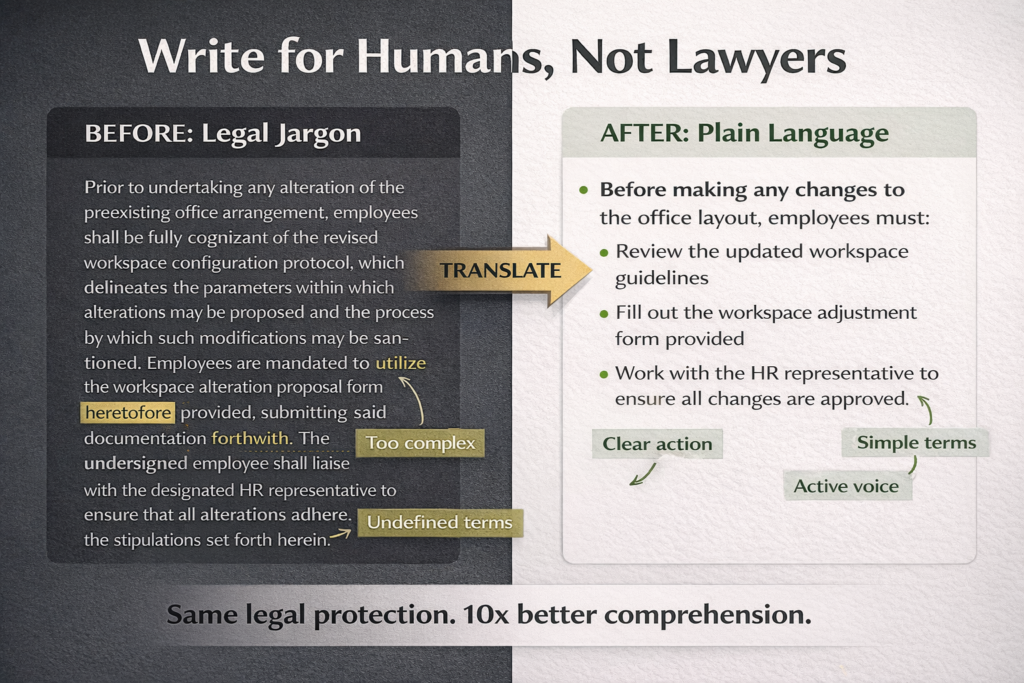
Here’s a before and after:
Before: “Employees requesting utilization of available paid time off must submit requests through the designated system no less than fourteen (14) calendar days prior to the proposed absence, subject to manager approval based on operational requirements and equitable distribution of time-off requests among team members.”
After: “Request time off at least two weeks in advance through [system name]. Your manager will approve requests based on team coverage needs and fairness across the team. For last-minute needs, talk with your manager as early as possible.”
Same policy. Radically different user experience.
Phase 4: The Rollout is the Strategy
You’ve spent months creating this masterpiece. Don’t just email it out and call it done. Treat your HRWP launch like a product launch:
Create a rollout plan: Multi-channel communication (email, team meetings, manager briefings, all-hands presentation), phased over 2-3 weeks.
Develop manager toolkits: Your managers will get questions. Arm them with FAQs, talking points, escalation guidance, and training on the most significant policy changes.
Host Q&A sessions: Create space for employees to ask questions in real-time. Record these for people who can’t attend live.
Make it accessible: Don’t bury the HRWP in your intranet. Make it searchable, mobile-friendly, and easy to navigate. Consider an interactive version where people can filter by topic.
Require acknowledgment thoughtfully: Yes, you need documented proof people received it. But make the acknowledgment process respectful—give people reasonable time to review, create multiple access points, accommodate different working styles.
Communicate what changed: Don’t make employees play spot-the-difference. Explicitly highlight new policies, significantly revised policies, and anything they need to act on.
Phase 5: The Bi-Annual Review Ritual
Your HRWP cannot be static. Laws change. Your business changes. Work changes. Build in the review process from day one:
Every six months: Legal compliance scan. Have any relevant laws or regulations changed? Update immediately if needed.
Annually: Full policy review by your policy pod. What’s working? What’s creating friction? What questions keep coming up? What’s missing?
Continuously: Track metrics that indicate policy health—policy-related questions to HR, manager escalations, employee complaints, exit interview themes, policy violations. These are your early warning system.
Treat your HRWP as a living document that evolves with your organization, not a static relic that ossifies.
Case Studies & Controversies: Real-World Lessons
Theory is helpful. Reality is instructive. Here’s what I’ve learned from organizations that got it spectacularly right and devastatingly wrong.
Case Study A: How a 50-Person Startup Scaled to 300 Without HR Fires
A tech company I advised took an unusual approach when building their first formal HRWP at the 50-person mark. Instead of starting with templates, they started with values and worked backward.
They identified their actual operating principles—how they really made decisions, what behaviors actually got rewarded, what made people successful there. Then they built policies that codified and protected those principles.
Example: they valued “default to yes” for employee requests. So instead of policies that required approval for everything, they created policies that assumed permission and specified the few exceptions requiring review.
Their remote work policy: “Work where you work best. Some roles require specific locations—we’ll be clear about those in job descriptions. For everyone else, coordinate with your team and keep your manager informed.”
Their professional development policy: “You own your growth. The company provides an annual development budget, access to our learning library, and dedicated development time. You decide how to use these resources in alignment with your role and career goals.”
As they scaled to 300, this values-first approach meant their culture survived growth. New managers weren’t making up rules—they were applying stated principles. Employees weren’t confused about expectations—they could reference policy that actually reflected reality.
Their turnover rate remained below industry average through hypergrowth. Their engagement scores stayed high. And critically, they avoided the common startup trap where “early chaos charm” becomes “late-stage organizational dysfunction.”
Case Study B: The $2M Lesson: When a “Copy-Pasted” Handbook Failed
A regional healthcare company acquired another firm and simply extended their existing HRWP to the acquired employees without review. This handbook had been copied years earlier from a template designed for California employers.
The acquired company operated primarily in Colorado and New York. The problems emerged quickly:
The handbook’s non-compete provisions were unenforceable under Colorado law, which had recently restricted non-competes. When several key employees left to join a competitor, the company couldn’t enforce restrictions they’d assumed were valid.
The handbook’s meal break provisions followed California requirements (specific timing, specific durations, specific penalty structures). New York law has different requirements. The company inadvertently violated New York labor law for months, creating wage and hour liability.
The handbook described an “unlimited PTO” policy that had worked for the original company’s culture but created massive operational problems in the acquired company where coverage-based scheduling was critical.
When one employee was terminated, they sued for wrongful termination, arguing the progressive discipline procedures in the handbook created an implied contract. The case settled for seven figures, mostly because the handbook language was impossible to defend—it had been written for a different state’s laws and a different operational model.
The total cost including settlement, legal fees, wage-hour penalties, and operational disruption exceeded $2M. All preventable with a $15K policy review and update.
The lesson: your HRWP must be specific to your legal jurisdictions, your operational model, and your culture. Templates and copy-paste approaches create massive risk.
The Great Controversy: Flexibility vs. Fairness
One debate surfaces in nearly every HRWP development process: should policies allow manager discretion or mandate uniform application?
The Flexibility Argument: Rigid policies can’t account for every situation. Managers need room to consider context, individual circumstances, and business needs. Discretion enables compassion and business agility. Example: requiring manager approval for remote work allows consideration of role requirements, team dynamics, and individual performance.
The Fairness Argument: Discretion creates inconsistency. Employees in the same situation get different treatment based on who their manager is. This breeds resentment, perceptions of favoritism, and legal vulnerability if discretion patterns create disparate impact. Example: requiring uniform remote work standards ensures everyone is held to the same criteria.
Both positions have merit. Both have failed spectacularly in different contexts.
My view after reviewing hundreds of these situations: the answer depends on what you’re optimizing for and your organizational maturity.
Early-stage companies and small teams can usually handle more discretion because trust and communication are high. Large organizations or those with compliance-heavy industries need more uniformity because consistency is both a legal requirement and an operational necessity.
The synthesis approach: define the principle and the boundaries, then grant discretion within those bounds. For remote work: “Work arrangements should optimize for individual productivity and team effectiveness. Managers have discretion to approve arrangements that meet these criteria. Arrangements cannot disadvantage employees based on protected characteristics, must ensure adequate customer coverage, and must include clear communication and accountability structures.”
This gives managers room to make contextual decisions while preventing arbitrary or discriminatory application.
HRWP Myths vs. Facts: Setting the Record Straight
Let’s address the misconceptions that lead organizations astray:
Myth: “Once employees sign acknowledgment, we’re fully protected.”
Fact: Acknowledgment proves they received the handbook, not that you followed it or that it’s legally sound. Courts regularly find against employers despite signed acknowledgments when the policy itself is problematic or when the company didn’t follow its own stated procedures. Acknowledgment is necessary but nowhere near sufficient.
Myth: “The longer and more detailed the handbook, the better protected we are.”
Fact: Excessive detail creates excessive obligation. Every procedure you outline is a procedure you must follow. Every situation you try to anticipate is another potential inconsistency. The most effective HRWPs are comprehensive on principles and key processes but don’t try to script every hypothetical scenario. Length creates liability.
Myth: “Our lawyers wrote it, so it’s optimized for our business.”
Fact: Attorneys optimize for legal defensibility, which is important but incomplete. They minimize risk of lawsuits. They don’t optimize for employee engagement, operational efficiency, manager enablement, or cultural reinforcement. A legally sound HRWP that nobody follows or that crushes morale is a business failure even if it’s a legal success. You need legal review, but legal shouldn’t be the only author.
The 7 Deadly Sins of HRWP Writing
Avoid these common mistakes that undermine even well-intentioned policy efforts:
The Sin of Obscurity: Using legal jargon, corporate speak, and passive voice that obscure meaning. Your HRWP should be written at an 8th-grade reading level. If employees need a law degree to understand it, you’ve failed.
The Sin of Omniscience: Trying to anticipate and prescribe procedures for every possible scenario. This creates an unreadable tome that’s outdated the moment you publish it. Accept that you can’t script everything. Establish principles and give people judgment frameworks.
The Sin of Immutability: Treating the HRWP as permanent once published. Printing physical copies that can’t be updated. Creating processes so burdensome that updates never happen. Your HRWP must evolve with your business or it becomes an anchor.
The Sin of Isolation: Writing policy in an HR silo without input from managers, employees, legal, or operations. This produces technically correct policies that fail in practice because they ignore operational realities.
The Sin of Inconsistency: Creating contradictions between your HRWP and other documents like offer letters, employment agreements, or benefits guides. Employees will exploit gaps. Courts will rule against you based on the most employee-favorable interpretation.
The Sin of Ignorance: Failing to track changes in employment law and update accordingly. Laws change constantly—wage requirements, leave entitlements, non-compete restrictions, classification rules. An outdated HRWP is a liability, not a shield.
The Sin of Boredom: Creating a document so dense and dull that nobody reads it until they’re already in trouble. Use formatting, examples, plain language, and visual elements to make your HRWP accessible. An unread policy might as well not exist.
FAQs: Answering “People Also Ask” & Employee Questions
Q: Is an HRWP legally required?
The answer varies significantly by jurisdiction. In the United States, federal law doesn’t mandate a comprehensive handbook, but does require specific notices (FMLA eligibility if applicable, EEO poster information, etc.). Many states add requirements—California requires meal break policies, New York requires harassment policies, various states mandate paid leave notices.
Internationally, requirements differ dramatically. EU countries often require works councils and specific employee consultation processes. Some countries mandate certain policies be in employment contracts rather than handbooks.
Even where not strictly required, an HRWP is practically essential for any organization with more than 10 employees. It’s your primary defense against claims of inconsistent treatment and your evidence that employees were informed of expectations.
Q: Can an HRWP be changed, and how?
Yes, HRWPs can and should be updated regularly. However, the process matters tremendously.
Best practice: Include a clear statement in your HRWP that it may be modified at any time with appropriate notice. Define what “appropriate notice” means—typically 30 days for significant changes.
When making changes, communicate clearly what’s different and why. Require new acknowledgment if the changes are substantial. Maintain version control so you can prove what policy was in effect when.
Never make changes retroactively or in ways that harm existing employee entitlements without explicit consent. For example, you can’t reduce already-accrued vacation balances just by changing your policy.
Some jurisdictions require employee consent for certain changes or have specific notice requirements. Know your local laws.
Q: What’s the difference between an HRWP and an employee handbook?
These terms are often used interchangeably, and for most purposes, they refer to the same document—the comprehensive guide to your workplace policies, procedures, and expectations.
Some organizations use them distinctly: “employee handbook” for the friendly overview given to new hires, and “HRWP” or “policy manual” for the complete, detailed policy documentation. This can create version control nightmares.
My recommendation: use one comprehensive document but create different access points for different users. New hires might get a “quick start guide” that highlights key policies with links to full details. Managers might get a version with additional implementation guidance. But maintain one authoritative source of truth for actual policy.
Q: How do we handle employees who refuse to acknowledge the HRWP?
This is a legitimate concern. Acknowledgment isn’t optional—it’s a condition of continued employment.
First, ensure you’ve actually provided adequate opportunity to review. Don’t require acknowledgment in the middle of new hire paperwork overwhelm. Give reasonable time and multiple access methods.
If an employee still refuses, document your attempts and have a direct conversation. Understand why they’re refusing—sometimes it reveals legitimate concerns about policy content that you need to address.
If the refusal persists without legitimate reason, treat it like any other insubordination. Explain that acknowledgment is required as a condition of employment. Document the refusal. If it continues, it’s grounds for termination.
However, note that acknowledgment only proves receipt, not agreement. Employees don’t have to agree with your policies to be bound by them (as long as the policies themselves are legal and reasonable).
Q: Should we include specific disciplinary actions in the HRWP?
This is the flexibility versus fairness debate in microcosm. My position: describe your disciplinary philosophy and process, but avoid absolute prescriptions.
Good approach: “We address performance and conduct issues through progressive discipline appropriate to the severity and frequency of the issue. This typically involves coaching, documented conversation, formal warning, final warning, and termination. We reserve the right to skip steps or move directly to termination for serious violations including but not limited to violence, theft, harassment, or gross insubordination.”
This gives you a framework without boxing you into rigid sequences that may not fit every situation.
Bad approach: “First violation: verbal warning. Second violation: written warning. Third violation: suspension. Fourth violation: termination.”
This creates an implied contract that courts may enforce. It also prevents appropriate responses to serious issues.
Your HRWP is Your Operating System
Your Human Resources Workplace Policy is the operating system for your company’s human capital. A bad OS crashes constantly, creates security vulnerabilities, and frustrates users until they find alternatives. A great one enables everything else to run smoothly—applications launch reliably, data stays secure, users accomplish their goals with minimal friction.
Most organizations are running HR-DOS when they should be running HR-iOS. They’re patching problems reactively instead of building robust systems proactively. They’re creating policies that protect the company from employees instead of policies that protect everyone while enabling performance.
Here’s my final expert advice: Don’t start with a rewrite. Start with an audit.
Your goal isn’t a perfect document by Friday. Your goal is to identify the single policy causing the most friction right now and fix that first. Is it your promotion process creating perceptions of favoritism? Fix that. Is it your remote work ambiguity creating manager headaches? Fix that. Is it outdated non-compete language creating legal exposure? Fix that.
Momentum beats perfection. Small wins build capability and buy-in for larger efforts.
And remember: an HRWP isn’t something you write and forget. It’s something you steward. It’s a living artifact of your culture, your values, and your commitment to treating people fairly while running an effective business.
The companies that get this right don’t have fewer problems. They have better systems for addressing problems. They don’t avoid tough conversations. They have clearer frameworks for having them. They don’t eliminate manager discretion. They bound it with principle and accountability.
That’s the difference between an HRWP that sits in a folder and an HRWP that actually works.
Ready to Transform Your HRWP?
Download Our HRWP Audit Checklist & Template Bank: Get the exact frameworks I use with clients to assess policy effectiveness and identify critical gaps. Includes customizable templates for 15 essential policies and a prioritization matrix to focus your efforts where they matter most.
Explore Our Remote Work Policy Case Study: See how a 200-person distributed company built a remote-first HRWP that reduced manager questions by 60% and improved engagement scores by 23 points.
Need Expert Support?: For complex, multi-state, or international HRWP reviews, our team provides comprehensive audit services, policy development, and manager training. We don’t do templates—we build custom solutions for your specific context, culture, and compliance requirements.
ALSO READ: Rowdy Oxford Lawsuit: What It Means, Why It Matters, and How to Protect Yourself

Jesse Zanger is the managing editor of aldalive.com and is based in New York City. He earned a degree in Philosophy from Hamilton College in 1998. Jesse has spent his entire professional career in New York, reporting on both local and national news for MacNeil/Lehrer Productions, Spectrum News NY1, Fox News, and 5ebackgrounds.com. During his time at local News Channel, he was part of the team that helped introduce the on-screen news crawl shortly after 9/11. As a member of the leadership team at 5ebackgrounds.com, the site has received notable industry honors, including a New York State Broadcasters Association Award (2019) and a Regional Edward R. Murrow Award (2017).