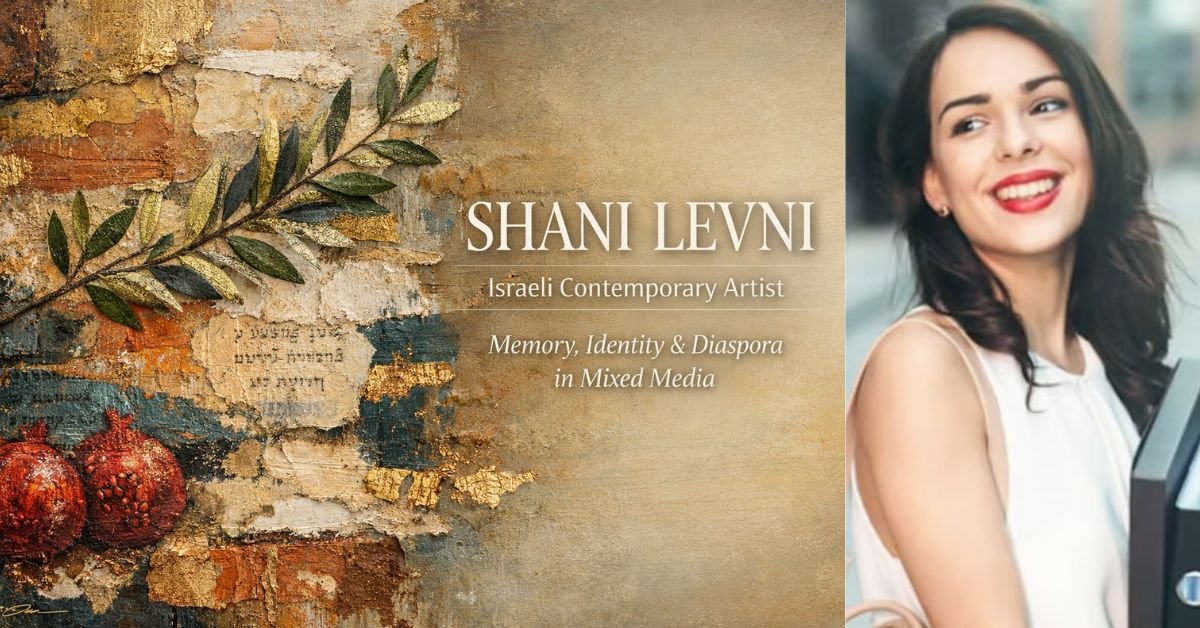
Shani Levni has emerged as a distinctive voice in contemporary art, creating mixed-media works that bridge personal heritage with universal themes of memory, identity, and displacement. This Israeli contemporary artist combines rigorous formal training with community-engaged practice, producing layered compositions that invite viewers into profound questions about belonging and cultural narrative. This profile provides a verified, in-depth examination of her life, artistic practice, and growing impact on the international art scene.
Biography & Cultural Foundations
Shani Levni was born in Tel Aviv and received her foundational training at the prestigious Bezalel Academy of Arts and Design in Jerusalem, one of Israel’s leading institutions for art education. She later pursued an MFA in Art Theory in Berlin, deepening her conceptual framework and expanding her international perspective.
Her cultural heritage draws from both Sephardic Moroccan and Eastern European roots, a dual ancestry that informs the thematic complexity of her work. This multicultural background provides her with what she describes as a “double vision”—an ability to hold multiple narratives simultaneously, which manifests in the layered, often contradictory elements within her compositions.
While specific details about her age and family life remain unverified in public sources, Levni has been transparent about how her upbringing in Tel Aviv and subsequent time in Berlin shaped her artistic sensibility. The contrast between these two cities—both marked by complex histories of displacement and cultural convergence—continues to influence her exploration of diaspora and belonging.
Artistic Style: Symbols, Layers, and Memory as Material
Levni’s artistic methodology centers on making memory tangible. Through her use of layering, texture, and strategic erasure, she creates surfaces that function as archaeological sites—each stratum revealing traces of what came before while acknowledging what has been lost or obscured.
Her technique often involves building up multiple layers of paint, paper, fabric, and found materials, then selectively removing portions to reveal underlying elements. This process of accretion and subtraction physically embodies the way memory works: imperfect, fragmented, with certain moments standing in sharp relief while others fade into abstraction.
Levni’s work is frequently categorized within abstract expressionism, though her approach is distinctly conceptual. Rather than pursuing pure emotional gesture, she employs abstraction as a language for exploring specific cultural and historical questions. Mixed media serves not merely as aesthetic choice but as philosophical position—the combination of disparate materials mirrors the hybrid identities and fractured histories that concern her.
Recurring Symbols in Levni’s Visual Language
The Olive Tree: Beyond its conventional association with peace, Levni’s olive tree imagery carries multiple meanings. It represents rootedness and displacement simultaneously—a tree that can live for thousands of years yet can be uprooted in an instant. The olive tree also functions as a symbol of Mediterranean identity, connecting diverse cultures across contested geographies.
Pomegranate Imagery: In her work, pomegranates appear as symbols of abundance, fertility, and the multitude contained within unity. The fruit’s numerous seeds enclosed in compartments resonates with themes of diaspora—separate yet bound together.
Gold Leaf and Metallic Elements: Levni incorporates gold leaf not as decoration but as a marker of what is precious, sacred, or worthy of preservation. These shimmering elements often highlight text fragments or specific compositional areas, directing the viewer’s attention to moments of particular significance.
Text Fragments: Partially legible words in Hebrew, Arabic, and occasionally other languages appear throughout her work. These fragments—never fully readable—evoke the incomplete transmission of cultural memory across generations and borders.
Recurring Themes in Levni’s Oeuvre
Diaspora & Displacement: Much of Levni’s work grapples with the experience of being culturally scattered, of maintaining identity across geographic and temporal distances. Her compositions often suggest movement, transition, and the liminal spaces between departure and arrival.
Spiritual Inquiry: Without affiliating with specific religious traditions, Levni explores spirituality as a human impulse toward meaning-making and transcendence. Her work acknowledges the sacred while remaining open to interpretation across belief systems.
Silence & Voice: A persistent tension in her practice involves what can and cannot be spoken. Many works feature areas of deliberate emptiness or erasure, representing silenced narratives or experiences beyond language. Yet these silences are active rather than passive—they demand acknowledgment.
Notable Works & Exhibition History
Whispers of the Olive Tree (2018)
This piece, displayed at the Tel Aviv Museum of Art, represents a watershed moment in Levni’s career. The work features a large-scale canvas combining paint, fabric, and embedded organic materials, including actual olive leaves preserved in resin. The composition suggests both a specific tree and a forest, both rootedness and dispersal.
Critics praised the work for its restraint—rather than making explicit political statements, it created space for viewers to bring their own associations with this culturally loaded symbol. The piece now resides in the museum’s permanent collection.
Letters Never Sent
Exhibited at the Jerusalem Biennale, this installation took a participatory approach. Levni invited community members—particularly those from immigrant backgrounds—to contribute anonymous letters they had written but never sent. These were incorporated into a large-scale mixed-media installation featuring fragments of text partially obscured by layers of translucent material.
The interactive nature of the piece expanded Levni’s practice beyond individual expression toward collective testimony. It embodied her belief that personal memory always intersects with communal history.
Between Earth and Sky (2020)
This solo exhibition at Rosenfeld Gallery in Tel Aviv showcased a series of works exploring verticality and horizon lines. The paintings and installations in this show emphasized the threshold between terrestrial and celestial, material and spiritual, grounded identity and transcendent aspiration.
The exhibition cemented Levni’s reputation for creating contemplative spaces within the gallery context, works that reward sustained attention and resist quick consumption.
A Parallel Universe
An earlier verified exhibition that demonstrated Levni’s developing visual language, this show introduced many of the symbolic and technical elements that would become signatures of her mature work.
Beyond the Canvas: Activism & The Root Collective
For Levni, the distinction between art-making and social engagement is artificial. In 2017, she co-founded The Root Collective, an initiative providing free art workshops to refugees, asylum seekers, and recent immigrants in Israel.
The Root Collective operates on the premise that creative expression is essential for processing trauma and building community. Workshop participants work with materials similar to those in Levni’s studio practice—creating layered compositions that help them visualize and externalize their experiences of displacement.
One of the collective’s most visible projects was the Jaffa Refugee Center Mural Project, where workshop participants collaborated to create a large-scale public artwork. The mural, featuring symbols and text in multiple languages, stands as both artistic achievement and political statement about belonging and visibility.
Levni views this community art practice not as separate from her studio work but as its natural extension. Both involve making space for stories that might otherwise remain untold, using visual language to articulate what words cannot capture.
Her public engagement has extended to speaking opportunities, including a TEDx talk in Jaffa about art’s role in social healing, and collaboration with UNESCO on arts education initiatives.
Critical Reception & Future Trajectory
Art critics have consistently praised Levni for balancing emotional depth with formal sophistication. Her work has been described as creating “contemplative urgency”—inviting meditation while insisting on engagement with difficult questions.
Museum acquisitions of her work by institutions including the Tel Aviv Museum of Art signal growing institutional recognition. Collector interest has expanded beyond Israel to include European and North American buyers drawn to her synthesis of personal narrative and universal themes.
Looking forward, Levni has a solo exhibition planned for 2025 at a major European institution, details of which are forthcoming. Additionally, a documentary about her practice and The Root Collective is in production, scheduled for release in 2026, which will provide unprecedented access to her creative process and community work.
Frequently Asked Questions
Where can I see Shani Levni’s artwork in person?
Levni’s work is part of the permanent collection at the Tel Aviv Museum of Art. For current exhibitions, check listings at Rosenfeld Gallery in Tel Aviv, which represents her work. Her public murals, created through The Root Collective, can be viewed in Jaffa. Exhibition schedules change regularly, so consulting these institutions’ websites directly ensures current information.
What is the main message behind Shani Levni’s art?
Rather than conveying a single message, Levni’s work creates space for exploring questions about memory, identity, and belonging. She investigates how personal and collective histories intersect, how cultural heritage can be both anchor and burden, and how art might facilitate healing and understanding. The open-ended nature of her abstraction invites viewers to bring their own experiences and interpretations.
Is Shani Levni involved in any social causes?
Yes, social engagement is integral to her practice. Through The Root Collective, which she co-founded, Levni provides art workshops for refugees, asylum seekers, and immigrants. This work reflects her belief that creative expression is essential for processing displacement and building community. She has also participated in public discourse through speaking engagements and collaborations with organizations like UNESCO.
How would you describe Shani Levni’s artistic style?
Levni works primarily in abstract mixed media, creating layered compositions that combine paint, fabric, found materials, and text. Her style draws from abstract expressionism but maintains strong conceptual foundations. Characteristic elements include rich texture, symbolic imagery (olive trees, pomegranates, gold leaf), strategic erasure, and multilingual text fragments. The work balances aesthetic beauty with conceptual depth.
What artists or movements influence Shani Levni?
While Levni’s work connects to broader movements in abstract expressionism and contemporary art exploring memory and diaspora, she has developed a distinctive visual language. Her academic background in art theory at Bezalel Academy and in Berlin provided exposure to diverse traditions, and her multicultural heritage offers unique perspective. Rather than direct stylistic imitation, she synthesizes various influences into an approach specifically suited to her thematic concerns.
More Searches: Israeli contemporary artist, mixed media artist, The Root Collective, Tel Aviv Museum of Art, contemporary art Israel
This profile represents information available through documented exhibitions, institutional records, and verified public sources. As Levni’s career continues to evolve, new works and projects will further develop her artistic narrative.

Jesse Zanger is the managing editor of aldalive.com and is based in New York City. He earned a degree in Philosophy from Hamilton College in 1998. Jesse has spent his entire professional career in New York, reporting on both local and national news for MacNeil/Lehrer Productions, Spectrum News NY1, Fox News, and 5ebackgrounds.com. During his time at local News Channel, he was part of the team that helped introduce the on-screen news crawl shortly after 9/11. As a member of the leadership team at 5ebackgrounds.com, the site has received notable industry honors, including a New York State Broadcasters Association Award (2019) and a Regional Edward R. Murrow Award (2017).