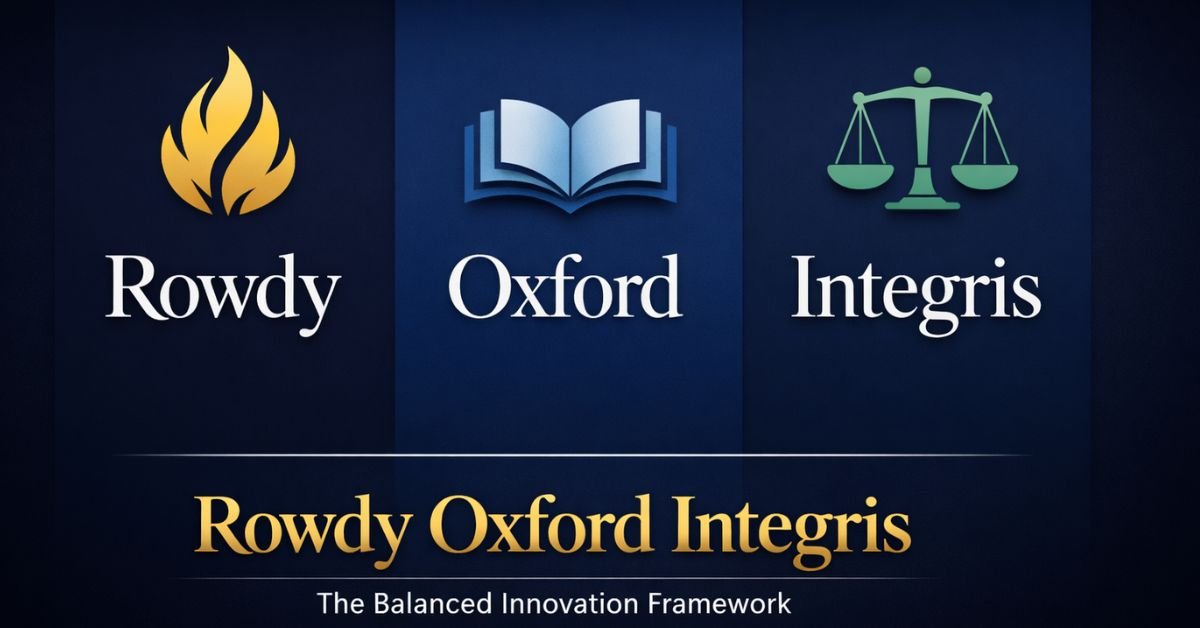
Rowdy Oxford
Integris
A structured philosophy of balanced innovation — where emotional courage, intellectual rigour, and ethical responsibility converge to create meaningful, sustainable progress.
What happens when creative rebellion meets academic discipline and is grounded in unwavering ethical responsibility? The answer is a framework that has quietly reshaped how forward-thinking individuals, organisations, and communities approach innovation. It is called Rowdy Oxford Integris — and it represents far more than a catchy three-word phrase. It is a mindset, a philosophy, and a structured pathway to achieving meaningful, sustainable progress in every area of life.
This guide will take you from the very foundations of what Rowdy Oxford Integris means, through the logic behind its three core pillars, and all the way to a practical step-by-step process you can begin using today. Whether you are an educator shaping young minds, a business leader navigating complexity, or an individual seeking authentic personal growth, this framework has something profound to offer.
What is Rowdy Oxford Integris? Beyond the Name
At first glance, “Rowdy Oxford Integris” might seem like an unusual combination of words. “Rowdy” evokes energy, rebellion, and bold action. “Oxford” carries connotations of intellectual rigour, centuries of scholarship, and structured thinking. “Integris” derives from the Latin root meaning integrity — wholeness, honesty, and moral completeness. Together, these three words are not random. They are deliberately chosen to represent three essential dimensions that, when balanced, produce extraordinary outcomes.
Rowdy Oxford Integris — often shortened to the ROI framework — is best understood as a philosophy of balanced innovation. It posits that lasting progress cannot come from just one of these dimensions in isolation. Pure rebellion without structure leads to chaos. Pure intellect without emotional courage leads to stagnation. And neither creativity nor discipline means anything if it is not anchored in ethical responsibility. The framework exists to bring all three into dynamic equilibrium.
Rowdy Oxford Integris is not a place, a brand, or a product. It is a conceptual framework — a way of thinking and acting that integrates emotional courage, intellectual rigour, and ethical grounding into a single, coherent approach to innovation and personal growth.
The Three Pillars: Rowdy, Oxford, and Integris
The power of Rowdy Oxford Integris lies in the interplay between its three pillars. Each one is necessary. Each one, on its own, is incomplete. Understanding what each pillar demands — and how they support one another — is the first step toward mastering the framework.
Rowdy
Emotional courage, creative disruption, and the boldness to challenge convention.
Oxford
Intellectual rigour, structured thinking, and evidence-based reasoning.
Integris
Ethical foundation, moral clarity, and accountability for outcomes.
The “Rowdy” Element: Emotional Courage & Creative Disruption
The Rowdy pillar is the engine of innovation. It represents the willingness to challenge convention, to ask uncomfortable questions, and to pursue ideas that others might dismiss as too bold or too unconventional. This is not recklessness for its own sake. It is deliberate, purposeful creative disruption — the kind that has driven every significant breakthrough in human history.
Emotional courage is the fuel behind the Rowdy element. It takes courage to present an idea that contradicts the status quo. It takes courage to fail publicly and learn from that failure. And it takes courage to stand behind your convictions even when the room disagrees. The Rowdy pillar celebrates this courage and cultivates it as a core skill.
In practice, the Rowdy element shows up as: a willingness to experiment, a comfort with ambiguity, an appetite for feedback even when it is critical, and an ability to reimagine problems from entirely new angles.
The “Oxford” Element: Intellectual Rigour & Structured Thinking
If the Rowdy pillar provides the spark, the Oxford pillar provides the framework in which that spark can burn productively. Oxford represents intellectual discipline — the commitment to research, analysis, structured reasoning, and evidence-based thinking. It is the part of the framework that ensures your bold ideas are not just exciting, but actually sound.
Structured thinking is a skill that can be developed. It involves breaking complex problems into manageable parts, evaluating evidence objectively, considering multiple perspectives, and arriving at conclusions that are both logically sound and practically actionable. The Oxford pillar honours centuries of intellectual tradition while remaining completely adaptable to modern challenges.
In practice, the Oxford element shows up as: thorough research before decision-making, a habit of questioning assumptions, the ability to construct well-reasoned arguments, and a deep respect for knowledge as a foundation for action.
The “Integris” Element: Ethical Foundation & Moral Clarity
The Integris pillar is what transforms innovation from a neutral act into a force for good. It represents ethical responsibility — the commitment to ensuring that your creative and intellectual endeavours serve a purpose greater than personal gain. Without Integris, even the most brilliant ideas can cause harm.
Moral clarity does not mean rigid dogmatism. It means having a clear internal compass that guides your decisions, especially when the path forward is ambiguous. It means asking not just “Can I do this?” but “Should I do this? Who benefits? Who might be harmed? Is this sustainable?” The Integris pillar builds these questions into the very foundation of how you think and act.
In practice, the Integris element shows up as: transparent communication, accountability for outcomes, consideration of long-term consequences, and a genuine commitment to creating value for others alongside yourself.
Historical Evolution: From Community Concept to Global Framework
Rowdy Oxford Integris did not emerge overnight from a single stroke of genius. Like most enduring frameworks, it evolved gradually — shaped by communities, thinkers, and practical challenges over time. Its roots lie in community-centred spaces where people who valued both creative freedom and intellectual depth came together to share ideas, collaborate on projects, and hold one another accountable to shared ethical standards.
In its earliest form, the concept was less a formal framework and more an implicit culture — an atmosphere where boldness was celebrated, rigour was expected, and integrity was non-negotiable. Over time, as this culture proved its value across diverse contexts, local thinkers and organisers began to articulate its principles more explicitly. Patterns were identified, terminology was refined, and the three-pillar structure that we recognise today began to take shape.
What makes the historical evolution of Rowdy Oxford Integris particularly noteworthy is its adaptability. Unlike frameworks tied to a single discipline or industry, ROI was designed from the ground up to be flexible. Its core principles translate seamlessly from education to business, from personal development to community building. This universality is not an accident — it is a direct consequence of the framework being built on human fundamentals rather than industry-specific assumptions.
Practical Applications: Where ROI Transforms Outcomes
In Education: Developing Critical Thinkers with Conscience
Education is one of the most natural homes for the Rowdy Oxford Integris framework. Teaching is, at its best, an act of empowering young people to think boldly, reason clearly, and act responsibly. When educators consciously embed ROI principles into their approach, classrooms become environments where curiosity-driven learning thrives alongside ethical development.
A Rowdy element in education looks like encouraging students to challenge textbook assumptions, pursue passion projects that push boundaries, and embrace failure as a learning tool. The Oxford element looks like teaching research methodology, critical analysis, and evidence-based argumentation. And the Integris element looks like embedding values-based learning — teaching students not just what they can do, but what they should do, and why it matters.
In Business: Balancing Innovation with Ethical Responsibility
In the business world, the tension between innovation and responsibility is felt acutely. Move too slowly, and you fall behind competitors. Move too fast without adequate thought, and you risk reputational damage, regulatory backlash, or worse. Rowdy Oxford Integris offers a proven path through this tension.
Companies that adopt the ROI framework develop cultures where experimentation is encouraged but grounded in solid research and ethical guardrails. Leadership teams use the three-pillar model to evaluate new initiatives: Is this idea bold enough to move the needle? Is it backed by rigorous analysis? Does it serve our stakeholders responsibly? When all three answers are yes, the organisation has found its next great move.
This approach does not slow organisations down — it actually accelerates sustainable growth by reducing the costly mistakes that come from acting without intellectual discipline or ethical foresight.
In Personal Development: Achieving Authentic Growth
Perhaps the most transformative application of Rowdy Oxford Integris is in personal development. When you apply this framework to your own life, it becomes a powerful tool for achieving what psychologists call self-actualisation — the process of realising your fullest potential while remaining grounded in who you truly are.
The Rowdy pillar challenges you to pursue your ambitions fearlessly, to take calculated risks, and to stop letting fear of judgment dictate your choices. The Oxford pillar pushes you to invest in continuous learning, to think critically about your goals, and to make decisions based on evidence rather than impulse. And the Integris pillar reminds you that authentic growth is not selfish — it is about becoming someone who contributes meaningfully to the world around you.
Implementation Guide: Adopting the ROI Mindset
Understanding a framework intellectually is only the beginning. The real value of Rowdy Oxford Integris emerges when you begin to live it. The following implementation process is designed to take you from awareness to active practice in a structured, manageable way.
Step 1: Self-Assessment
Before you can balance the three pillars, you need an honest picture of where you currently stand. Reflect carefully on the following:
- Rowdy: How often do you challenge your own assumptions or pursue ideas others might dismiss? Do you take creative risks, or do you play it safe?
- Oxford: How rigorous is your thinking process? Do you research before deciding, or do you rely primarily on intuition? How comfortable are you with complex analysis?
- Integris: How deliberately do you consider the ethical implications of your decisions? Are your actions aligned with your stated values? Do you hold yourself accountable?
Most people find that one or two of these dimensions come naturally, while the third requires conscious development. This imbalance is normal — and identifying it is the most important first step.
Step 2: Building Your Practice
- Start with your strongest pillar. Build confidence by doubling down on what comes naturally. If you are naturally bold, lean into creative projects. If you are naturally analytical, deepen your research habits.
- Introduce your weakest pillar in small doses. If ethical reflection is your blind spot, begin each week by asking yourself one values-based question about your upcoming decisions. If intellectual rigour is the gap, commit to reading one research-based article per day.
- Create feedback loops. Share your goals with a trusted mentor or peer who can hold you accountable. Regular check-ins — even brief ones — dramatically increase follow-through.
- Integrate all three in a single project. Choose one meaningful challenge and consciously apply all three pillars to it. Use the Rowdy mindset to define the bold vision. Use the Oxford mindset to build a rigorous plan. Use the Integris mindset to ensure the project serves a purpose beyond yourself.
- Reflect and adjust weekly. Spend ten minutes at the end of each week reviewing where you applied each pillar, where you fell short, and what you will do differently. This habit of reflective practice separates people who understand the framework from those who truly master it.
Step 3: Overcoming Common Challenges
Case Studies: Real-World Success with the Framework
Theory gains credibility through evidence. The following case studies illustrate how Rowdy Oxford Integris principles have been applied across different contexts to produce measurable, meaningful results.
A Tech Startup Scaling with Purpose
A small technology startup faced a familiar dilemma: how to grow rapidly in a competitive market without sacrificing the values that made it special. The founding team introduced the ROI framework into their decision-making process. Every major product decision was evaluated through three lenses: Was it innovative enough to stand out? (Rowdy) Was it backed by user research and market data? (Oxford) Would it genuinely improve people’s lives without causing unintended harm? (Integris)
Within eighteen months, the startup saw a 40% increase in customer retention. More importantly, the team reported higher morale and a stronger sense of shared purpose.
↑ 40% Customer RetentionAn Educational Programme Reimagined
A regional education initiative sought to move beyond rote learning and develop students who could think independently and act ethically. Educators adopted the ROI framework as a guiding philosophy for curriculum design. They created assignments that required students to take creative risks (Rowdy), conduct genuine research (Oxford), and present their findings with a clear ethical argument (Integris).
After one academic year, student engagement scores rose by 35%, and graduates consistently outperformed their peers in collaborative problem-solving assessments.
↑ 35% Student EngagementA Community Leader’s Personal Transformation
A community organiser struggling with burnout and unclear direction began applying the ROI framework to her personal and professional life. She identified that her Rowdy pillar was strong — she was passionate and action-oriented — but her Oxford and Integris pillars needed development. She committed to a structured learning plan and incorporated regular ethical reflection into her weekly routine.
Over six months, she reported a dramatic reduction in burnout and a marked increase in the impact of her community programmes.
↓ Burnout, ↑ Programme ImpactComparison: ROI vs. Similar Frameworks
Rowdy Oxford Integris does not exist in isolation. Several well-known frameworks address overlapping themes. Understanding how ROI differs helps clarify when and why it is the right choice.
| Framework | Core Focus | Key Difference from ROI |
|---|---|---|
| Ikigai | Finding purpose at the intersection of passion, mission, vocation, and profession. | Ikigai is primarily a personal fulfilment model. ROI explicitly integrates ethical responsibility and is designed for organisational application. |
| Golden Circle | Understanding and communicating your Why, How, and What. | The Golden Circle is a communication and leadership tool. ROI is a broader innovation and growth framework addressing creativity, rigour, and ethics simultaneously. |
| Design Thinking | Human-centred problem-solving through empathy, ideation, and prototyping. | Design Thinking is a process methodology. ROI is a mindset framework that can encompass design thinking as one of its tools. |
| Maslow’s Hierarchy | Understanding human motivation from basic needs to self-actualisation. | Maslow’s model is descriptive — it explains human behaviour. ROI is prescriptive — it provides an actionable pathway to growth. |
The unique advantage of Rowdy Oxford Integris is its three-way integration. While many frameworks excel in one dimension, ROI is specifically designed to hold all three pillars in balance — making it particularly well-suited to complex challenges that require creativity, rigour, and ethics working in concert.
Honest Assessment: Limitations & Pitfalls
No framework is perfect, and intellectual honesty demands that we acknowledge the potential weaknesses of Rowdy Oxford Integris alongside its strengths.
Frequently Asked Questions
It is a conceptual framework. While the term has occasionally been associated with community spaces and lifestyle destinations, its core identity is philosophical — a structured approach to balancing creativity, intellect, and ethics in pursuit of meaningful innovation and growth.
Ikigai focuses on finding personal purpose at the intersection of passion, mission, vocation, and profession. ROI shares the emphasis on balance but adds an explicit ethical dimension and is designed to be applied not just personally but also in organisations, education, and community settings.
Absolutely. The key is understanding that boldness and rigour are not simultaneous demands — they are sequential. You ideate with a Rowdy mindset, then plan and evaluate with an Oxford mindset. Many successful companies already do this intuitively; ROI simply makes the process explicit and teachable.
Start with a self-assessment. Identify which of the three pillars comes most naturally to you, and which requires the most development. Then choose one small, concrete action that exercises your weakest pillar — and commit to it for at least two weeks before adding complexity.
The framework has been adopted across a range of sectors including technology, education, and community development. The growing body of case studies and the framework’s adaptability have driven increasing interest among leaders seeking a more holistic approach to innovation.
Success is measured across both quantitative and qualitative indicators. Quantitative metrics might include project outcomes, retention rates, or growth figures. Qualitative indicators — often more telling — include team cohesion, decision-making quality, ethical consistency, and personal fulfilment. A balanced scorecard approach works best.
The most common pitfalls include neglecting your weakest pillar, trying to force balance too quickly, and treating the framework as a one-time exercise rather than an ongoing practice. Consistency and patience are essential. Think of ROI as a long-term investment in yourself and your organisation — not a short-term fix.
Conclusion: The Future Belongs to Those Who Balance
We live in an era that celebrates innovation above almost everything else. But innovation without direction is just noise. Rowdy Oxford Integris offers something rare in a world of competing frameworks and methodologies: a genuinely integrated approach that honours the creative spirit, demands intellectual excellence, and insists on ethical responsibility — all at the same time.
This is not a framework for the faint of heart. It asks you to be bold, to think deeply, and to hold yourself to a high standard. But for those willing to embrace the challenge, Rowdy Oxford Integris is more than a mindset — it is a foundation for a life and a career built on purpose, rigour, and meaning.
The three pillars are not a destination. They are a practice. And like any practice worth pursuing, the greatest rewards come not from perfection, but from the sustained commitment to growth.
Be bold. Think deeply. Act with integrity.
CLICK HERE FOR MORE INFORMATIVE BLOG POSTS

Jesse Zanger is the managing editor of aldalive.com and is based in New York City. He earned a degree in Philosophy from Hamilton College in 1998. Jesse has spent his entire professional career in New York, reporting on both local and national news for MacNeil/Lehrer Productions, Spectrum News NY1, Fox News, and 5ebackgrounds.com. During his time at local News Channel, he was part of the team that helped introduce the on-screen news crawl shortly after 9/11. As a member of the leadership team at 5ebackgrounds.com, the site has received notable industry honors, including a New York State Broadcasters Association Award (2019) and a Regional Edward R. Murrow Award (2017).