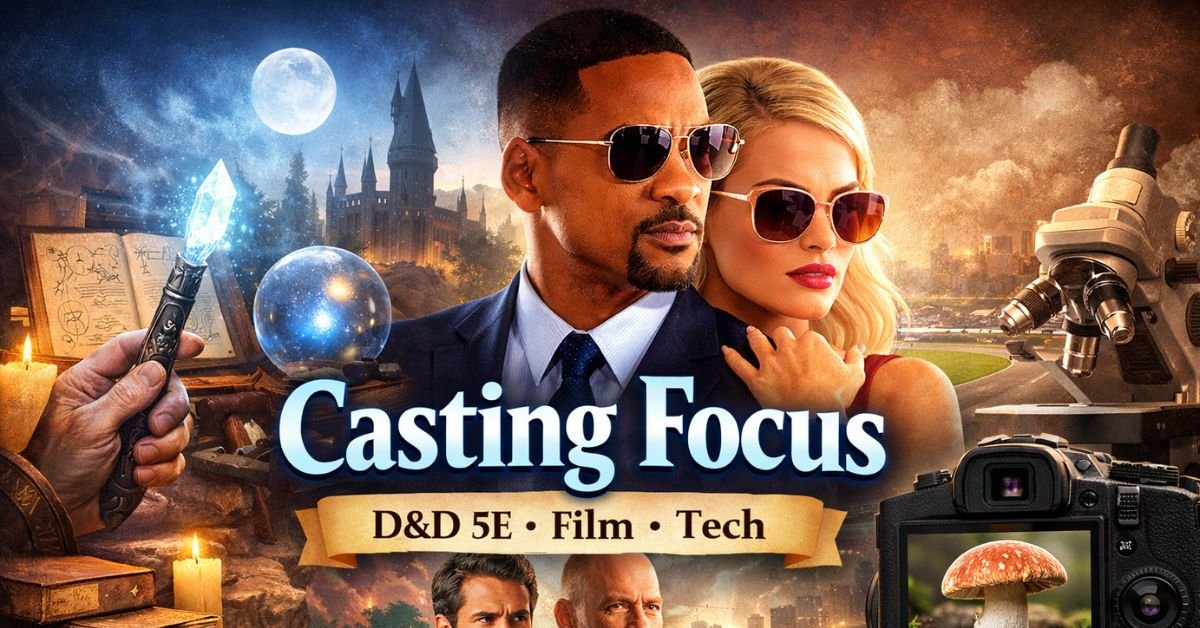
The phrase “casting focus” appears across surprisingly different worlds. In one context, it describes a magical tool wielded by a fantasy spellcaster. In another, it refers to the starring lineup of a 2015 Hollywood film. And in yet others, it touches on photography, science, and niche gaming terminology.
This guide is designed to cut through the confusion. Whether you landed here searching for D&D rules, movie trivia, or something else entirely, the sections below are organised to get you to the right answer fast. The dominant search intent — and the most detailed coverage here — centres on Dungeons & Dragons 5th Edition, where “casting focus” (formally called a spellcasting focus) is a core mechanic for many character classes.
Part 1: Casting Focus in Dungeons & Dragons 5E
Spellcasting Focus in D&D 5E: Rules and Uses
In D&D 5E, a spellcasting focus is a specific type of item that certain classes can use to channel and cast spells. Rather than rummaging through a component pouch every time they invoke magic, a spellcaster can hold or wear a single focus item and use it to satisfy the Material (M) component requirement for most spells.
Not every class benefits from a focus equally. The rules tie focus use to specific classes and, in some cases, to particular class features or subclass choices.
Common Spellcasting Focus Types
| Focus Type | Common Classes | Description |
| Orb | Wizards, Sorcerers | A smooth, often glass or crystal sphere held in the palm. |
| Crystal | Wizards, Sorcerers | A raw or polished gemstone used to channel arcane energy. |
| Wand | Wizards, Sorcerers, Warlocks | A thin stick of wood or bone, often tipped with a gem. |
| Rod | Wizards, Clerics, Paladins | A sturdy implement, sometimes engraved with runes. |
| Staff | Wizards, Clerics, Druids | A tall wooden or metal pole; can double as a weapon. |
| Holy Symbol | Clerics, Paladins | A holy emblem worn or held, specific to the deity worshipped. |
Which Classes Use a Spellcasting Focus?
Wizards are the archetype focus-user. Their class description explicitly permits arcane foci (orbs, crystals, wands, rods, and staves). A wizard’s spellbook is legendary, but their focus is what turns memorised formulas into living magic.
Sorcerers draw magic from within, but they too can equip an arcane focus. Their innate charisma fuels their power, and the focus serves as a conduit to shape that raw energy outward.
Warlocks have a unique relationship with foci. Their pact with a patron may grant them specific focus options. Some Warlock subclasses (such as the Hexblade) gain the ability to use a weapon as their focus — blurring the line between martial and magical.
Clerics and Paladins typically use a holy symbol as their focus. This can be a holy symbol worn around the neck, painted on a shield, or held in the hand. Importantly, a holy symbol must be the focus of the deity the character worships.
Artificers (introduced in Tasha’s Cauldron of Everything) are unique in that their tools serve as their focus. They infuse mundane objects with magic, and a tool they are proficient with functions as their spellcasting focus.
Casting Focus Rules & FAQs
| Key Rule A spellcasting focus can replace non-costly Material (M) components that are not consumed by the spell. It cannot replace Verbal (V) or Somatic (S) components, nor can it substitute for costly or consumed materials. |
Do you need a focus to cast spells?
Not necessarily. A focus is one way to satisfy Material component requirements. The alternative is a component pouch — a small pouch containing all the common, inexpensive ingredients a spellcaster might need. You only strictly need a focus (or a component pouch) when a spell lists an M component. Spells that require only V and/or S components need neither.
Can you cast spells without a focus?
Yes. If you have a component pouch, you can use it in place of a focus for standard spells. Some spells with no Material component at all — such as many damage and utility spells — require nothing beyond speech and gestures. A focus is a convenience, not an absolute requirement for every spell.
Do you need an arcane focus to cast cantrips?
This is one of the most commonly asked questions, and the answer depends on the cantrip. If a cantrip lists an M component in its description, then yes — you would need either a focus or a component pouch to cast it. However, the majority of cantrips (Fire Bolt, Mage Hand, Light, Prestidigitation, and many others) have no M component at all. For those, no focus is needed. Check the component line of the specific cantrip to be sure.
What about Sorcerers, Warlocks, and other classes?
Each class interacts with foci slightly differently. Sorcerers can use an arcane focus but also benefit from their innate magical ability — their focus is more of a channelling aid than a hard requirement for many of their spells. Warlocks may have focus options tied to their Patron or Pact. And as noted above, Artificers use tools as their focus, making their approach entirely unique among spellcasting classes.
How to Use a Casting Focus: Practical Tips for Players
The free-hand rule: Many spells require a Somatic (S) component — a specific gesture. The Player’s Handbook states that casting a spell with an S component requires a free hand. If your focus is in one hand and you’re wielding a weapon in the other, you cannot cast an S-component spell. Plan your action economy around this.
Holding your focus while casting: If your spell requires both S and M components, you can use the same hand to hold the focus and make the gesture — the focus is the conduit for the spell, so the motion incorporates it naturally.
Shield users beware: A holy symbol painted on a shield can serve as a focus for Clerics, but you still need a free hand for S-component spells. If both hands are occupied (shield + weapon), you’ll need to stow one before casting.
Role-play your focus: A focus is more than a mechanical tool — it’s a piece of your character’s identity. Consider what kind of focus fits your character’s personality, background, and magic style. A scholarly wizard might favour an ancient crystal, while a rogue-turned-sorcerer might use a single enchanted coin.
Part 2: The Cast of the Movie “Focus” (2015)
The “Focus” Movie Cast: Starring Will Smith & Margot Robbie
If your search for “casting focus” was actually about the 2015 film Focus, you’re in the right place. This is a comedy-drama about a seasoned con artist and his ambitious apprentice, set against a backdrop of high-stakes hustles in Buenos Aires and the glamorous world of Formula One racing. The film is entirely unrelated to D&D or spellcasting — the word “focus” here refers to a con artist’s technique of directing a victim’s attention.
Main Cast
| Actor | Role | Description |
| Will Smith | Nicky Spurgeon | The charming, seasoned con artist who leads a large-scale pickpocketing operation. |
| Margot Robbie | Jess Barrett | A young, resourceful woman who becomes Nicky’s apprentice and love interest. |
| Rodrigo Santoro | Alejandro Garriga | A rival con artist who challenges Nicky in a high-stakes bet during a Formula One event. |
| Gerald McRaney | Owens | A wealthy and eccentric businessman who becomes a key mark in the film’s second act. |
| Ana de Armas | Kira | A younger woman involved in the Buenos Aires con sequence. |
| BD Wong | Farhad | A quirky and enthusiastic member of Nicky’s con crew. |
| Adrian Martinez | Julio | Another colourful member of the pickpocketing team in Buenos Aires. |
Behind the Scenes & Trivia
Directors: Glenn Ficarra and John Requa co-wrote and co-directed the film. The pair are known for their work on comedies and had previously collaborated on I, Tonya and other projects.
Reception: Focus received mixed reviews from critics, with praise directed at the chemistry between Will Smith and Margot Robbie and the film’s stylish visual presentation. It performed respectably at the box office, grossing over $100 million worldwide against a moderate budget.
Will Smith’s filmography context: Focus arrived during a period when Smith was transitioning between action and drama roles. The film showcased his comedic range and charm, qualities that had defined his earlier career hits.
Part 3: Other Uses of “Casting Focus”
Other Media and Technical Meanings
The phrase “casting focus” doesn’t stop at D&D and the 2015 film. It surfaces in several other contexts — some well-known, others quite niche. This section addresses them so that no matter how you arrived at this page, you can find what you’re looking for.
In Other Films and TV
Auto Focus (2002): This is a biographical thriller, not to be confused with the 2015 film Focus. Auto Focus tells the story of Bob Crane, the actor best known for playing Colonel Hogan in the 1960s TV series Hogan’s Heroes, and his descent into increasingly dangerous personal behaviour. The film stars Greg Kinnear as Crane and Cole Hauser as his associate. It is a darker, more serious film than Focus and has an entirely different cast and tone.
The Faulkner Focus and other news/media programmes: Various news outlets and media programmes use “focus” in their branding. If you’re searching for a specific news segment or editorial programme, the best approach is to include the network or outlet name alongside your search term to narrow results.
In Technical and Niche Contexts
Photography & Videography
“Focus” is a fundamental concept in photography and videography, referring to the sharpness and clarity of the subject in an image or frame. “Casting” in this context might refer to the act of selecting or directing talent for a video or film shoot. When these terms appear together, they usually relate to the process of directing and filming a subject — ensuring both the cast and the camera are performing at their best.
Microscopy & Science
In laboratory and scientific settings, “cast” can refer to a prepared specimen or mould, while “focus” relates to the precise adjustment of a microscope or optical instrument to achieve a clear image. Preparing a cast “in focus” means ensuring the specimen is properly aligned and the optics are tuned for maximum clarity.
“Cast Mushroom at Focus Macro” — A Niche Reference
This phrase occasionally appears in online searches and gaming forums. It most likely refers to a very specific command or macro within an online multiplayer game — possibly Final Fantasy XIV, World of Warcraft, or another MMO — where “cast” is a game action, “mushroom” is a spell or ability name, and “focus macro” is a targeting technique that locks onto a specific ally or enemy. If you are searching for this exact phrase, we recommend including the name of the game you are playing in your search query for the most accurate and helpful results.
Conclusion
“Casting focus” is a phrase that means something very different depending on where you encounter it. Here is a quick recap of the three main meanings covered in this guide:
- D&D 5E — The Spellcasting Focus: A spellcasting focus is an item — an orb, wand, holy symbol, or similar object — used by certain classes to channel magic and satisfy Material component requirements. It is a core part of the spellcasting system for Wizards, Sorcerers, Warlocks, Clerics, Paladins, and Artificers.
- The 2015 Film — Focus (Cast): The movie Focus stars Will Smith and Margot Robbie in a story about con artists. The “casting” here refers to the selection of actors for the film, and the title “Focus” refers to a con artist’s technique of misdirection.
- Other Uses: The phrase also appears in photography (camera focus and directing talent), microscopy (specimen preparation), and niche gaming contexts (macro commands in MMOs). These are less common but worth noting for completeness.
| The Core Answer If you searched for “casting focus” and are playing D&D 5E, the answer is this: a spellcasting focus is a crucial item for spellcasters. It lets you replace standard Material components with a single magical object, freeing you to focus on the spells themselves. Choose one that fits your character, keep a hand free for Somatic components, and you’re set. |
We hope this guide has pointed you in the right direction — whether you’re building a wizard, debating movie trivia, or hunting down an obscure gaming macro. Feel free to jump back to whichever section is most relevant to your query.

Jesse Zanger is the managing editor of aldalive.com and is based in New York City. He earned a degree in Philosophy from Hamilton College in 1998. Jesse has spent his entire professional career in New York, reporting on both local and national news for MacNeil/Lehrer Productions, Spectrum News NY1, Fox News, and 5ebackgrounds.com. During his time at local News Channel, he was part of the team that helped introduce the on-screen news crawl shortly after 9/11. As a member of the leadership team at 5ebackgrounds.com, the site has received notable industry honors, including a New York State Broadcasters Association Award (2019) and a Regional Edward R. Murrow Award (2017).