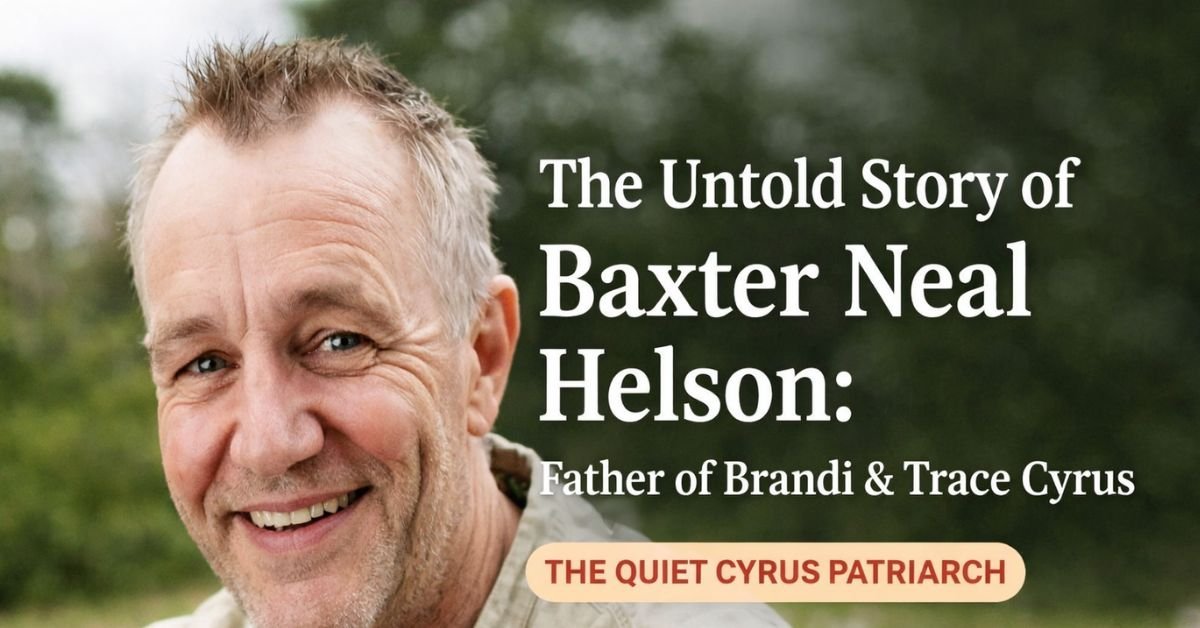
In the glittering narrative of the Cyrus family’s rise to fame, one figure remains deliberately absent from the spotlight: Baxter Neal Helson. As the biological father to Brandi and Trace Cyrus and the first husband of Tish Cyrus, Helson represents a foundational chapter in the Cyrus family story that predates their stratospheric fame. A drummer by trade and a private individual by choice, Baxter Neal Helson has maintained a life of intentional obscurity even as his children became household names. This comprehensive exploration delves into the complete story of the man whose genetic legacy helped shape two members of America’s most famous musical family, while he himself chose to remain a quiet contributor rather than a public figure.
Early Life & Background: Kentucky Roots & Musical Beginnings
Childhood in Kentucky: Formative Years Before Fame
Born in 1966 in Kentucky, Baxter Neal Helson grew up in a state renowned for its rich musical heritage spanning bluegrass, country, and rock traditions. Kentucky, nestled in the Appalachian region, has long been a crucible of American musical innovation, and it was within this culturally vibrant environment that young Baxter developed his identity. Details about his specific birthplace within Kentucky and his family background remain scarce, consistent with the intensely private life he would later cultivate. What is known suggests a childhood shaped by the working-class values and musical traditions common to the region during the 1960s and 1970s.
Growing up in this era meant exposure to a diverse musical landscape. Kentucky in the late 1960s and 1970s was experiencing the cultural shifts of rock and roll, the persistence of traditional country music, and the evolution of Southern rock. These formative years would prove instrumental in shaping Helson’s eventual choice to pursue drumming as both a passion and a profession. The Kentucky native would carry these Appalachian roots throughout his life, even as geographical and personal circumstances took him far from his birthplace.
Discovering Rhythm: The Making of a Drummer
Baxter Neal Helson’s journey to becoming a drummer began in his youth, though specific details about his musical education remain largely undocumented. What is clear is that by young adulthood, percussion had become his primary musical identity. The drummer—often described as the heartbeat of any band—occupies a unique position in musical ensembles: essential yet frequently backgrounded, providing rhythm and structure while other instruments claim melodic attention. This role would prove metaphorically appropriate for Helson’s later life approach.
Drumming in Kentucky’s local music scene during the 1980s meant participation in a network of small venues, community events, and regional bands. The state’s musical landscape offered opportunities for dedicated musicians to develop their craft, even if national recognition remained elusive for most. Helson’s developing musical identity centered on rhythm, tempo, and the technical precision that distinguished competent drummers from exceptional ones. His passion for percussion would become one of the defining elements of his identity, alongside his later role as a father.
Interestingly, this musical foundation may have created an unexpected legacy: his son Trace Cyrus would also pursue a career in music, first as the frontman and guitarist for the band Metro Station and later as a solo artist. Whether this musical lineage represents direct paternal influence or simply genetic inclination remains a matter of speculation, given the limited public information about Helson’s relationship with his children during their formative years.
Pre-Cyrus Life: Education, Early Adulthood & Aspirations
The years immediately preceding Baxter Neal Helson’s marriage to Tish Cyrus remain among the most obscure aspects of his biography. Information about his educational background, whether he pursued formal music training, and his early career aspirations has never been publicly documented. This gap in the historical record reflects both the pre-internet era’s limited documentation of non-famous individuals and Helson’s later commitment to privacy.
What can be reasonably inferred is that by his early twenties, Helson was actively pursuing music as a vocation, playing in local bands throughout Kentucky and potentially surrounding states. The life of a regional musician in the 1980s was characterized by modest financial rewards, intense dedication, and the constant navigation between artistic passion and practical necessity. For many musicians of this era, the dream of breakthrough success coexisted with the reality of day jobs, irregular income, and the challenge of building a sustainable career in an unforgiving industry.
By 1986, when Helson married Tish, he was already established as a drummer within the local music community. His identity as a musician would remain a core aspect of who he was, even as the responsibilities and complexities of marriage and fatherhood would soon reshape his life priorities. These formative pre-fame years represent the foundation of a man whose life would become inextricably linked with one of America’s most famous families, yet who would ultimately choose to remain separate from that fame.
Marriage to Tish Cyrus & Family Foundation Years
Meeting & Marriage: The Union That Connected Him to Destiny
The story of how Baxter Neal Helson met Leticia “Tish” Finley (later Tish Cyrus) has never been publicly detailed, but their connection appears to have developed within Kentucky’s social and musical circles in the mid-1980s. Tish, born in 1967, would have been approximately 19 years old when she married Helson in 1986, while Baxter was around 20. Their young marriage reflected patterns common to their generation and region, where early marriages were more socially normative than in contemporary society.
The romantic connection between the young drummer and his future wife unfolded against the backdrop of Reagan-era America, when the music industry was experiencing significant transformation. MTV had revolutionized music consumption, and the cultural landscape was shifting rapidly. For a young couple starting their life together, the future must have seemed filled with possibility, even if the specific trajectory—one that would eventually lead to extraordinary fame for Tish and their children—could not have been imagined.
Their marriage in 1986 represented the beginning of a family unit that would soon expand. Whatever dreams and plans the young couple harbored for their future together, they were entering a partnership that would fundamentally shape both of their lives, albeit in dramatically different ways. For Helson, this marriage would connect him permanently to a family legacy that would achieve fame far beyond anything he might have envisioned as a regional drummer in Kentucky.
Parenthood: Biological Father to Brandi & Trace Cyrus
Baxter Neal Helson became a father twice during his marriage to Tish Cyrus. Their daughter Brandi Glenn Cyrus was born on May 26, 1987, followed by their son Neil Timothy “Trace” Cyrus on February 24, 1989. These children would become the biological legacy that permanently connected Helson to the Cyrus family narrative, even as his marriage to their mother would ultimately dissolve.
The early years of Brandi and Trace’s lives unfolded with Baxter as their biological father, though details about these formative years remain private. What family memories were created during this period, what role Helson played in his children’s early development, and what the daily dynamics of their household looked like are questions without public answers. What is known is that these years represented the entirety of Baxter’s time as a present father in a traditional family structure with his biological children.
Both Brandi and Trace would later achieve their own forms of public recognition. Brandi became a television personality, blogger, and DJ, appearing on shows like “Cyrus vs. Cyrus: Design and Conquer” and developing her own media presence. Trace pursued music intensively, first gaining fame as the frontman of Metro Station (known for the hit “Shake It”) and later as a solo artist and collaborator. Their paths into entertainment and music reflect both the influence of the Cyrus family environment they would later grow up in and possibly genetic inclinations inherited from their biological father’s musical background.
The question of how much Baxter Neal Helson’s own musical identity influenced his son’s later career remains speculative but intriguing. Did Trace’s passion for music emerge organically from watching his biological father play drums, or did it develop independently through later exposure to Billy Ray Cyrus and the broader Cyrus family’s musical environment? The answer likely involves elements of both biological predisposition and environmental influence, though the specific dynamics remain known only to the family members themselves.
Separation & Divorce: The Transition That Changed Everything
By the early 1990s, Baxter Neal Helson and Tish’s marriage had reached its conclusion. The couple separated and subsequently divorced, though the specific timing and circumstances have never been publicly detailed. What is documented is that this marital dissolution occurred before Tish met and began her relationship with Billy Ray Cyrus, the country music singer whose career was on the verge of explosive success.
The divorce represented a profound life transition for all parties involved. For Helson, it meant a fundamental reconfiguration of his relationship with his children and his role in their daily lives. For Tish, it opened the path to her eventual marriage to Billy Ray Cyrus in 1993, a union that would dramatically alter the trajectory of her and her children’s lives. For young Brandi and Trace, it marked the beginning of a blended family dynamic that would come to define their childhood and adolescence.
The practical and emotional complexities of this family transition cannot be understated. Divorce is challenging under any circumstances, but the subsequent development—Billy Ray Cyrus’s adoption of Brandi and Trace, followed by the family’s entrance into extraordinary fame—created a unique set of circumstances that few families navigate. For Baxter Neal Helson, the dissolution of his marriage was not simply the end of a relationship but the beginning of a decades-long reality in which his biological children would be raised primarily by another man and would bear that man’s famous surname.
The immediate aftermath of the divorce saw Helson’s life diverge sharply from the path his ex-wife and children would take. While they would soon be swept into the world of country music stardom and eventually broader entertainment fame, Helson would chart a different course—one characterized by privacy, distance from the spotlight, and an apparent choice to live life on his own terms, separate from the celebrity narrative unfolding around his biological offspring.
Musical Identity: The Drummer Behind the Scenes
Musical Style & Influences: Baxter Helson’s Artistic Identity
While comprehensive details about Baxter Neal Helson’s specific musical style and influences remain undocumented, his identity as a drummer situates him within broader patterns of percussion tradition and regional musical culture. Drummers emerging from Kentucky’s music scene in the 1970s and 1980s would have been exposed to diverse influences ranging from classic rock to Southern rock, country rhythms to emerging new wave sounds.
The role of the drummer demands particular technical skills: timing precision, rhythmic creativity, physical endurance, and the ability to serve the song rather than dominate it. Great drummers understand that their primary function is to provide the foundation upon which other musicians build their melodic and harmonic contributions. This perspective—being essential yet backgrounded—may offer insight into Helson’s later life philosophy of remaining private despite connections to fame.
Speculation about his influences might reasonably include the drumming giants of his formative decades: John Bonham of Led Zeppelin, Neil Peart of Rush, Stewart Copeland of The Police, and the countless session drummers who shaped the sound of 1970s and 1980s popular music. However, without direct testimony or documented interviews, these remain educated guesses rather than confirmed facts about Helson’s artistic inspirations and approach to percussion.
Band Associations & Local Music Career
Baxter Neal Helson’s musical career appears to have been primarily situated within Kentucky’s local and regional band circuit. Unlike musicians who achieve national recognition, regional players constitute the vast majority of working musicians—individuals who perform at local venues, community events, private functions, and small clubs, building modest careers through dedication and consistency rather than breakthrough success.
The specific names of bands Helson played with, the venues where he performed regularly, and the musical communities he participated in have not been publicly documented. This absence of detail is typical for musicians who operated primarily at the local level during the pre-internet era, when documentation of such activities was sporadic and largely confined to local newspapers, flyers, and word-of-mouth promotion.
What can be inferred is that Helson was sufficiently committed to music to identify professionally as a drummer, suggesting a level of skill and dedication that went beyond casual hobbyist status. The life of a regional musician requires significant time investment, equipment acquisition and maintenance, rehearsal dedication, and the willingness to perform regularly for modest compensation. That Helson sustained this identity through his twenties and beyond indicates genuine passion for the craft of percussion.
The Kentucky music scene of the 1980s and early 1990s, while not as nationally prominent as Nashville or Austin, maintained vibrant local networks where musicians could develop their skills, collaborate with other artists, and contribute to their communities’ cultural life. Helson’s participation in this ecosystem positioned him as part of America’s broader musical landscape—the tens of thousands of dedicated musicians whose collective efforts create the infrastructure of live music, even when individual recognition remains limited.
Legacy of Rhythm: How Music Defined His Identity
There exists a compelling philosophical parallel between Baxter Neal Helson’s role as a drummer and his approach to life amid his family’s fame. Drummers occupy a unique position in musical ensembles: they provide the essential rhythmic foundation that enables everything else to function, yet they typically remain visually and narratively backgrounded in favor of lead singers and melodic instrumentalists. This is not a subordinate position but rather a specialized one that requires both technical excellence and ego subordination to collective purpose.
Similarly, Helson’s biological contribution to the Cyrus family story is foundational—without him, Brandi and Trace Cyrus would not exist—yet he has chosen to remain deliberately absent from the narrative spotlight. Just as a drummer keeps time without demanding attention, Helson has maintained his genetic and historical connection to a famous family while eschewing any attempt to leverage that connection for personal publicity or gain.
This alignment between professional identity and life philosophy may not be coincidental. Musicians who gravitate toward percussion often possess particular personality traits: comfort with supporting roles, focus on technical precision over individual expression, and understanding that excellence can manifest through enabling others’ success rather than demanding individual recognition. Whether Helson consciously recognized this parallel or simply lived according to deeply ingrained preferences, the result has been a life remarkably consistent with the drummer’s ethos of essential contribution without spotlight seeking.
Music, it appears, has remained a defining element of Baxter Neal Helson’s identity even as other aspects of his life have evolved and changed. His designation as “Baxter Helson drummer” in search queries and casual references suggests that this professional identity has endured as his primary public descriptor, perhaps the one aspect of his life he has allowed to remain visible even as he has carefully guarded his privacy in other domains.
Life After Divorce: Privacy, Co-Parenting & Personal Journey
Geographical Moves: From Kentucky to Los Angeles & Beyond
Following his divorce from Tish Cyrus in the early 1990s, Baxter Neal Helson’s geographical trajectory included relocation to Los Angeles, California. This move represented a significant departure from his Kentucky roots and placed him, at least temporarily, in one of the world’s most prominent entertainment capitals. The timing and motivation for this relocation have not been publicly documented, though Los Angeles’s robust music scene would have offered professional opportunities for a working drummer.
Los Angeles in the 1990s was experiencing a dynamic musical period, with everything from the grunge movement to hip-hop’s golden age to continued rock and pop evolution. For a musician with Helson’s background, the city would have presented both opportunities and challenges: vastly more venues and potential collaborations than Kentucky could offer, but also significantly more competition and higher living costs. Whether Helson pursued active performance during his time in Los Angeles or maintained a lower musical profile remains unknown.
Interestingly, this Los Angeles period coincided with his children’s upbringing in Tennessee, where Tish and Billy Ray Cyrus were establishing their family base near Nashville. The geographical distance between Helson in California and his biological children in Tennessee represented a physical manifestation of the growing separation between his life path and theirs. This distance, whether chosen or necessitated by circumstances, would characterize the relationship dynamics for years to come.
Current information about Helson’s whereabouts remains elusive. Whether he has remained in Los Angeles, returned to Kentucky, or settled elsewhere is not publicly known as of 2026. This geographical obscurity is consistent with his broader pattern of privacy maintenance, effectively disappearing from public tracking even in an era of unprecedented digital surveillance and social media exposure. For someone determined to avoid attention, maintaining locational privacy has become one of the most effective strategies available.
Co-Parenting Dynamics with a Famous Family
The co-parenting arrangements between Baxter Neal Helson and Tish Cyrus following their divorce have never been publicly detailed, creating one of the most significant information gaps in understanding this family dynamic. What is known is that Billy Ray Cyrus legally adopted both Brandi and Trace, though the specific timing of these adoptions and whether they occurred before or during Billy Ray’s rise to fame has not been definitively established.
Legal adoption by a stepparent typically requires the biological parent’s consent or termination of parental rights. This legal process raises complex questions about Helson’s involvement and decision-making regarding his children’s future. Did he voluntarily consent to the adoptions, recognizing Billy Ray’s more substantial ability to provide for the children? Were there legal proceedings that resulted in termination of rights? Or did some other arrangement govern the transition of legal parenthood? These questions remain unanswered in public discourse.
The practical challenges of co-parenting when one parent becomes extraordinarily famous are unprecedented for most families. As Billy Ray Cyrus achieved massive success with “Achy Breaky Heart” in 1992 and the Cyrus family subsequently entered the broader entertainment world through Miley’s Disney Channel stardom and the family’s reality television presence, the disparity between the Cyrus household’s resources and lifestyle and whatever circumstances Helson experienced would have been profound.
How does a biological father maintain meaningful connection with children being raised in an environment of extraordinary wealth, fame, and opportunity that he cannot match? How do children navigate relationships with a biological father who exists outside the famous family narrative that defines their public identity? These questions suggest the emotional complexity underlying what might legally appear as straightforward adoption and blended family arrangements.
Neither Brandi nor Trace Cyrus has spoken extensively in public about their relationship with their biological father, maintaining a level of privacy about this aspect of their lives that mirrors Helson’s own approach to public disclosure. This mutual privacy may represent respect for Helson’s preferences, personal boundaries around a complex family situation, or simply the absence of a relationship significant enough to merit public discussion. Without direct testimony from those involved, outsiders can only acknowledge the complexity without presuming to understand its specifics.
Choosing Privacy: The Conscious Retreat from Public Life
Perhaps the most defining characteristic of Baxter Neal Helson’s post-divorce life has been his deliberate choice to avoid public attention. In an era characterized by social media oversharing, reality television celebration of private life, and the monetization of personal narratives, Helson’s sustained privacy represents a countercultural stance that demands recognition and perhaps respect.
Consider the opportunities Helson could have pursued if profit or attention had been his goals. As the biological father of two children connected to one of America’s most famous families, he could have sold his story to tabloids, written a tell-all memoir, pursued media interviews, or leveraged his connection for various forms of personal gain. The fact that he has done none of these things over multiple decades suggests a genuine commitment to privacy rather than merely strategic silence waiting for the right moment or offer.
This privacy choice becomes even more remarkable when considering the various Cyrus family developments that might have tempted lesser commitments to discretion: Miley Cyrus’s evolution from Disney star to controversial pop icon, the family’s reality television shows, Trace’s own musical career and public struggles, Billy Ray and Tish’s eventual divorce after 28 years of marriage, and countless other moments that generated intense media coverage. Through all of this, Helson has remained silent.
The motivations for such sustained privacy can only be speculated upon. Perhaps Helson values personal dignity and autonomy over potential financial gain. Perhaps he recognizes that entering the public narrative would only invite unwanted scrutiny and intrusion into his life. Perhaps he maintains respect for his children’s privacy and the family dynamics, even if those dynamics have not always included him centrally. Perhaps he simply prefers a quiet life and has the strength of conviction to maintain that preference despite external pressures.
Whatever the specific motivations, Baxter Neal Helson’s privacy represents a fascinating study in resistance to contemporary celebrity culture. While the Kardashians have built an empire on sharing every aspect of their lives, while reality television has normalized the broadcast of intimate family dynamics, and while social media has made privacy seem almost quaint, Helson has maintained boundaries that increasingly seem radical in their completeness. In doing so, he has preserved something increasingly rare: the right to exist without public consumption or commentary.
Relationship with Brandi & Trace Cyrus: Biological Father Bonds
Trace Cyrus Connection: Father to a Musician
Neil Timothy “Trace” Cyrus, born February 24, 1989, shares his biological father’s connection to music, though the specific influence Baxter Neal Helson had on Trace’s musical development remains unclear. Trace rose to prominence as the frontman, guitarist, and vocalist for Metro Station, the electronic pop-rock band that achieved mainstream success with their 2007 single “Shake It.” This track reached number 10 on the Billboard Hot 100 and became a defining song of the late 2000s pop-rock scene.
The question of musical lineage is intriguing: Trace’s biological father was a drummer, his adoptive father Billy Ray Cyrus is a country music singer, and his half-sister Miley became one of the most successful pop stars of her generation. With this concentration of musical talent and professional music careers in his immediate family, Trace’s own musical path seems almost overdetermined, though the specific influences that shaped his artistic development likely represent a complex interplay of genetics, environment, and individual passion.
Trace has been notably private about his relationship with his biological father, rarely if ever discussing Baxter Neal Helson in interviews or on social media. This silence might indicate limited or no current relationship, might reflect respect for Helson’s privacy preferences, or might simply represent Trace’s own boundaries around discussing complex family dynamics in public forums. The absence of public acknowledgment does not necessarily indicate absence of private connection, though it does suggest that any relationship that exists operates well outside public view.
Trace’s own life has been characterized by both creative success and personal struggles, including public discussions of addiction recovery and mental health challenges. Whether Baxter Neal Helson has been part of his son’s support system during difficult times, or whether Billy Ray Cyrus and the broader Cyrus family have exclusively filled paternal support roles, remains unknown. The complexity of blended family dynamics means that multiple father figures can coexist in a person’s life, each contributing differently to their development and well-being.
Brandi Cyrus Connection: Father-Daughter Dynamics
Brandi Glenn Cyrus, born May 26, 1987, has carved out her own career path distinct from music, working as a television personality, podcaster, DJ, and actress. She has appeared on Bravo’s “Cyrus vs. Cyrus: Design and Conquer” alongside her mother Tish, and hosts the podcast “Your Favorite Thing” with Wells Adams. Like her brother, Brandi has maintained public silence regarding her biological father, creating a parallel pattern of privacy around this aspect of their family history.
The father-daughter relationship between Baxter Neal Helson and Brandi represents another unknown dimension of this family story. Daughters’ relationships with their fathers often carry particular emotional weight and complexity, shaping their later relationships and self-concept in profound ways. Whether Helson has been a present figure in Brandi’s life, whether they maintain any contact, or whether Billy Ray Cyrus has exclusively occupied the paternal role are questions without public answers.
Brandi’s professional success and evident close relationship with her mother Tish suggest a stable family foundation, though this does not necessarily speak to the presence or absence of her biological father in her life. People can thrive with various family configurations, and the public success of Cyrus family members should not be taken as evidence either for or against Helson’s involvement in his children’s lives.
What is notable is that both Brandi and Trace appear to have adopted their biological father’s preference for privacy regarding this aspect of their family history. In a family known for reality television, social media engagement, and public sharing of personal details, this particular topic remains consistently off-limits. This mutual commitment to privacy might represent the one clear legacy Helson has provided his children: the modeling of boundaries and the right to keep certain aspects of life private, even when public interest is intense.
Adoption by Billy Ray Cyrus: Legal & Emotional Dimensions
Billy Ray Cyrus’s legal adoption of Brandi and Trace represents a crucial transition in the family’s legal and emotional structure, though specific details about when and how these adoptions occurred remain undisclosed. What is clear is that both children took the Cyrus surname and have publicly referred to Billy Ray as their father throughout their time in the public eye, suggesting that the legal adoption was accompanied by genuine paternal bonds and family integration.
Stepparent adoption in the United States typically requires either the biological parent’s voluntary consent or judicial termination of parental rights based on specific circumstances such as abandonment, unfitness, or other legal grounds. Without knowing which path the Cyrus family’s adoptions followed, it is impossible to draw conclusions about Baxter Neal Helson’s role in or resistance to these legal proceedings. Both paths can result in the same outcome—legal parenthood transferred to the adoptive parent—but through very different processes with different implications for the biological parent’s involvement and agency.
The emotional dimensions of adoption are complex for all parties involved. For Brandi and Trace, the adoption by Billy Ray Cyrus meant legal and social integration into a family that would provide extraordinary opportunities and experiences, even as it meant a formal legal severing of ties to their biological father. For Billy Ray, adoption represented a commitment to raise his stepchildren as his own, a responsibility he appears to have taken seriously throughout their upbringing. For Tish, the adoptions likely represented family cohesion and security for her children within her new marriage.
For Baxter Neal Helson, the emotional impact of these adoptions can only be imagined. Regardless of whether he consented willingly or had rights terminated, the legal reality that another man became the official father to his biological children represents a profound reconfiguration of identity and relationship. The fact that Helson has never spoken publicly about these adoptions or his feelings regarding them is consistent with his broader privacy stance, but that silence should not be mistaken for absence of feeling or significance.
The terminology surrounding these family relationships deserves attention: Brandi and Trace’s “real dad,” “biological father,” “birth father,” and similar phrases all carry different connotations and emphasize different aspects of the relationship. Billy Ray Cyrus is legally and socially their father, having raised them through their formative years and into adulthood. Baxter Neal Helson is biologically their father, having contributed half their genetic inheritance and been present for their early childhood. Both roles are real; both men are, in different ways, their fathers. The complexity of blended families means that simple categorizations often fail to capture the nuanced reality of relationships.
Baxter Neal Helson Today: Current Life & Lasting Legacy
Current Whereabouts & Occupation: Life in the Present
As of 2026, concrete information about Baxter Neal Helson’s current location, occupation, and daily life remains essentially nonexistent in public records. This extraordinary privacy achievement in the digital age represents either remarkable intentionality or genuine withdrawal from any activities that would generate public documentation. Unlike most Americans, whose digital footprints leave trails through social media, professional networks, public records, and countless other online presences, Helson appears to have successfully maintained anonymity.
Whether he continues to work as a drummer, has transitioned to other employment, or has retired remains unknown. Whether he still resides in Los Angeles, has returned to Kentucky, or has settled elsewhere is similarly undocumented. Whether he maintains active social media accounts under his own name or uses pseudonyms to avoid identification represents another unanswered question. The absence of confirmed photographs from recent decades further contributes to his ghost-like presence in the contemporary landscape.
This level of privacy is increasingly difficult to maintain as public records, property transactions, voter registrations, court records, and countless other bureaucratic interactions typically leave some digital trace. That Helson has avoided detectable presence in these systems suggests either residence in a location where such records are less accessible, use of legal privacy protections, or simply a lifestyle that minimizes activities that generate public documentation. Alternatively, information about his current life may exist in various databases but has not been aggregated or published due to lack of public interest from those with access to such resources.
The question of Helson’s current financial status also remains speculative. Did he negotiate any financial arrangements related to the adoptions of his children? Has he pursued stable employment over the decades since his divorce? Does he maintain a modest but comfortable existence, or has financial hardship been part of his experience? These questions, while natural to wonder about, may never receive public answers, representing yet another dimension of his successfully guarded private life.
Public Appearances & Media Interactions: Rare Moments
Documented public appearances or media interactions involving Baxter Neal Helson are essentially nonexistent. Unlike many individuals connected to famous families who occasionally surface in paparazzi photos, tabloid stories, or social media posts from mutual acquaintances, Helson has remained invisible to the media apparatus that tracks the Cyrus family with intense interest.
This absence is particularly remarkable given the numerous high-profile events in the Cyrus family history where a biological father might reasonably be expected to appear or be mentioned: Brandi and Trace’s career milestones, family celebrations, or even difficult moments when extended family support would be relevant. The fact that Helson has not been publicly identified at any of these occasions suggests either that he was not present, or that his presence went undetected by media observers—both possibilities that reinforce the extent of his privacy achievement.
There have been no verified interviews with Baxter Neal Helson, no confirmed statements through representatives, and no authorized biographies or personal accounts of his experience. This comprehensive silence represents a remarkable act of self-removal from public discourse, especially given the numerous moments when his perspective might have been valuable or sought after by media outlets covering Cyrus family developments.
The media’s general respect for this privacy—or perhaps their assessment that pursuing Helson’s story would yield no results—has created an unusual situation where a person connected to significant celebrity remains essentially unstudied and uncommented upon beyond basic biographical facts. In an era when even peripheral connections to famous families typically generate extensive coverage, Helson’s successful avoidance of this attention represents an anomaly worth acknowledging.
The Quiet Legacy: Influence Without Fame
Baxter Neal Helson’s legacy exists in a paradoxical space: biologically and historically foundational to the Cyrus family story, yet deliberately absent from its public narrative. This position might initially seem to reduce his significance, but upon deeper reflection, it may actually represent a particularly powerful form of influence—one that operates through genetics, early childhood presence, and the inheritance of values rather than through ongoing public participation or visibility.
His biological contribution to Brandi and Trace’s existence is absolute and irreplaceable. Whatever genetic predispositions they carry—whether toward musical talent, personality traits, physical characteristics, or health tendencies—reflects in part their paternal inheritance from Helson. This biological legacy persists regardless of legal adoption, ongoing relationship, or public acknowledgment. In this sense, Helson is permanently woven into the Cyrus family tapestry, even if his thread is not prominently displayed on the visible surface.
Perhaps more significant is the legacy of privacy and boundary-setting that Helson has modeled. In a family known for reality television, tell-all interviews, and public processing of personal struggles, Helson represents an alternative approach: the right to live life outside public consumption, to maintain dignity through discretion, and to value personal autonomy over potential fame or fortune. Whether his children have absorbed this lesson consciously or unconsciously, their own selective privacy regarding their relationship with him suggests that this value has been transmitted, even if the relationship itself remains private.
Helson’s quiet legacy also serves as a reminder of the countless individuals whose contributions to history are essential but unrecognized. For every famous person whose life receives extensive documentation, there are dozens of others—parents, early mentors, first loves, childhood friends—who shaped them in fundamental ways but remain invisible in the public narrative. Helson’s role as biological father to two members of the Cyrus family places him in this category: historically essential, publicly invisible.
Finally, there is something almost philosophical in Helson’s approach to his unusual circumstances. While many people dream of fame or connection to famous individuals, and while contemporary culture increasingly valorizes visibility and influence, Helson appears to have found peace in a very different path. Whether he views his biological children’s success with pride, regret, indifference, or some complex combination of emotions remains known only to him. But the consistency of his privacy over multiple decades suggests a person who has made peace with his choices and their consequences, living according to his own values rather than external pressures or expectations.
In this sense, Baxter Neal Helson’s legacy may ultimately be one of radical authenticity: choosing to live according to personal values of privacy and autonomy even when substantial opportunities for alternative choices presented themselves. This is influence of a different sort than fame or public recognition, but it may be influence nonetheless—the kind that operates quietly, through example rather than proclamation, through absence rather than presence.
Common Questions & Misconceptions About Baxter Neal Helson
Fact vs. Fiction: Separating Truth from Speculation
Given the scarcity of verified information about Baxter Neal Helson, it’s unsurprising that misconceptions and speculation have filled the knowledge gaps. Distinguishing confirmed facts from speculation requires careful attention to source reliability and acknowledgment of what simply remains unknown.
Confirmed Facts:
Baxter Neal Helson was born in 1966 in Kentucky. He worked as a drummer in local bands. He married Tish (Leticia Finley) in 1986. He is the biological father of Brandi Cyrus (born 1987) and Trace Cyrus (born 1989). He divorced Tish in the early 1990s. His children were later adopted by Billy Ray Cyrus. He relocated to Los Angeles at some point after the divorce. He has maintained privacy and has not spoken publicly about his family or personal life.
Common Misconceptions:
Some sources incorrectly state that Helson is Miley Cyrus’s biological father—this is false; Miley’s biological father is Billy Ray Cyrus. Some accounts suggest Helson achieved significant musical success or fame—there is no evidence of national recognition in his musical career. Speculation about the reasons for his divorce from Tish often appears in tabloid-style content, but no verified account of the marriage dissolution exists. Claims about his current net worth, occupation, or location are entirely speculative and should not be treated as factual.
The lesson here is to maintain appropriate epistemic humility: acknowledging what is known while resisting the temptation to present speculation as fact. Helson deserves this basic respect for accuracy, as does the audience seeking genuine information rather than tabloid speculation.
Why So Private? Understanding His Avoidance of Spotlight
The question of why Baxter Neal Helson has maintained such consistent privacy invites speculation, though definitive answers remain unavailable without direct testimony. Several possible explanations, either individually or in combination, might account for his approach:
Personal temperament: Some people are simply private by nature, valuing solitude and anonymity over attention and recognition. Helson may fall into this category, with his current privacy representing an authentic expression of longstanding personal preferences.
Protection from scrutiny: Connection to a famous family inevitably invites media investigation, public judgment, and potential exploitation. Avoiding public life may represent rational self-protection against unwanted intrusions and criticisms.
Respect for his children: Speaking publicly about his relationship with Brandi and Trace might create uncomfortable situations for them, invite unwanted media narratives, or violate their own privacy preferences. Silence might represent paternal consideration, even at a distance.
Lack of interest in fame: Not everyone desires public recognition. Helson may genuinely find no appeal in the celebrity or financial opportunities that connection to the Cyrus family might provide, preferring instead a quiet life on his own terms.
Complex emotions: The experience of having his children adopted by another man and raised in extraordinary circumstances he did not provide might involve painful emotions that make public discussion unappealing or impossible.
Philosophical conviction: Helson may hold strong beliefs about the value of privacy, the problems with celebrity culture, or the importance of living authentically according to personal values rather than external expectations.
Regardless of specific motivations, the consistency of Helson’s privacy over multiple decades suggests genuine commitment rather than temporary circumstance. This is not someone occasionally avoiding attention but someone who has built a life structured around privacy maintenance, suggesting deep-seated reasons beyond mere convenience or temporary preference.
His Place in Cyrus Family History: Assessing Historical Significance
Assessing Baxter Neal Helson’s place in Cyrus family history requires balancing his biological foundational role against his subsequent absence from the family’s public narrative. This is not a simple calculation but rather a nuanced evaluation that depends partly on how one defines significance and contribution.
From a strictly biological perspective, Helson’s significance is absolute: without him, Brandi and Trace Cyrus would not exist. This contribution is irreplaceable and permanent, regardless of subsequent developments in legal parenthood or ongoing relationships. In this sense, he is fundamental to the Cyrus family structure, even if that fundamentality is not publicly acknowledged or celebrated.
From a social and experiential perspective, Helson’s significance is more ambiguous. Billy Ray Cyrus raised Brandi and Trace, provided for them, guided them through childhood and adolescence, and is the father they publicly acknowledge. This social fatherhood carries profound weight and significance that cannot be dismissed simply because legal adoption was involved. The father who raises you shapes you in countless ways that biology alone cannot.
From a historical documentation perspective, Helson occupies a peculiar position: clearly important enough to merit mention in any comprehensive Cyrus family history, yet so absent from the ongoing narrative that he functions almost as a footnote—a necessary explanation of origin rather than an active character in the family story. This reflects both his own privacy choices and the family’s apparent decision to focus their public narrative around the family unit that formed after his departure.
Perhaps the fairest assessment is that Baxter Neal Helson holds dual significance: biologically and historically essential as the starting point of Brandi and Trace’s lives, yet experientially secondary to Billy Ray Cyrus’s role in their upbringing and development. This is not a value judgment but rather an acknowledgment of different types of contribution and significance. Both forms of fatherhood matter; both men occupy important if very different positions in this family’s history.
Ultimately, Helson’s place in Cyrus family history may be most accurately understood as that of the quiet foundation—essential to the structure but deliberately invisible in the facade. Without him, the family as we know it could not exist. But the family as we know it was built primarily by others, in ways that moved beyond and perhaps past his contribution. This is neither heroic nor tragic but simply the complex reality of blended families, changed circumstances, and individual choices about privacy and participation.
Frequently Asked Questions
Who is Baxter Neal Helson to Miley Cyrus?
Baxter Neal Helson is not directly related to Miley Cyrus by blood. He is the biological father of Brandi and Trace Cyrus, who are Miley’s older half-siblings through their mother Tish Cyrus. This makes Helson the biological father of Miley’s half-siblings, but he has no biological or legal relationship to Miley herself. Miley’s biological father is Billy Ray Cyrus, who also legally adopted Brandi and Trace after marrying Tish.
Is Baxter Neal Helson still married to Tish Cyrus?
No, Baxter Neal Helson and Tish Cyrus divorced in the early 1990s, several years after their 1986 marriage. Following their divorce, Tish married Billy Ray Cyrus in 1993. Tish and Billy Ray remained married for 28 years before eventually divorcing in 2022. There is no public information about whether Helson has remarried or his current relationship status.
Why did Billy Ray Cyrus adopt Brandi and Trace?
Billy Ray Cyrus adopted Brandi and Trace Cyrus after marrying their mother Tish in 1993. The specific circumstances and timeline of the adoptions have not been publicly detailed. Stepparent adoption is a common practice in blended families and typically serves to legally formalize the parental relationship that exists socially and emotionally. The adoption gave Brandi and Trace the Cyrus surname and established Billy Ray as their legal father, though Baxter Neal Helson remains their biological father.
What is Baxter Neal Helson doing now in 2026?
As of 2026, there is no publicly available information about Baxter Neal Helson’s current location, occupation, or daily life. He has maintained an extraordinarily private existence, with no confirmed social media presence, public appearances, or media interviews. Whether he continues to work as a drummer, has pursued other employment, or where he currently resides remains unknown. This privacy represents a deliberate and sustained choice over multiple decades.
Does Baxter Neal Helson have a relationship with his children today?
The current state of Baxter Neal Helson’s relationship with Brandi and Trace Cyrus is not publicly known. Neither Brandi nor Trace has spoken extensively about their biological father in public forums, and Helson himself has never given interviews about his family. This mutual privacy makes it impossible to definitively say whether they maintain contact, have an active relationship, or are estranged. The absence of public information should not be interpreted as evidence either way regarding the private reality of their relationships.
Has Baxter Neal Helson ever spoken publicly about the Cyrus family?
No, Baxter Neal Helson has never given public interviews, made statements to the media, or spoken publicly about the Cyrus family, his children, or his personal life. This comprehensive silence has been maintained for over three decades, through numerous high-profile Cyrus family events and media coverage. His consistent privacy represents a notable counterpoint to contemporary celebrity culture and tabloid journalism practices.
What kind of drummer was Baxter Neal Helson?
Baxter Neal Helson worked as a drummer in local bands within Kentucky’s music scene during the 1980s and early 1990s. Specific details about his musical style, the names of bands he played with, or his technical abilities have not been publicly documented. He appears to have been a dedicated regional musician rather than someone who achieved national recognition. His identification as a drummer remains one of the few consistent elements of his public identity.
How long were Baxter Neal Helson and Tish Cyrus married?
Baxter Neal Helson and Tish Cyrus were married in 1986 and divorced in the early 1990s, suggesting a marriage duration of approximately 5-7 years. The exact year of their divorce has not been publicly confirmed. During their marriage, they had two children: Brandi (born 1987) and Trace (born 1989). The marriage dissolution occurred before Tish met Billy Ray Cyrus, whom she married in 1993.
Where did Baxter Neal Helson grow up in Kentucky?
Baxter Neal Helson was born in Kentucky in 1966, but the specific city or region within Kentucky where he grew up has not been publicly documented. Kentucky is a diverse state with distinct regional cultures, from the Appalachian east to the western coalfields to the urban centers of Louisville and Lexington. Without more specific information, it’s not possible to determine which of Kentucky’s varied communities shaped his early life and development.
How is Baxter Neal Helson different from Billy Ray Cyrus as a father figure?
Baxter Neal Helson and Billy Ray Cyrus represent two different types of fatherhood to Brandi and Trace. Helson is their biological father who was present during their earliest years but from whom they were separated following his divorce from Tish in the early 1990s. Billy Ray Cyrus is their adoptive father who raised them through childhood and adolescence, provided for them, and is the father they publicly acknowledge. Helson contributed genetic inheritance and early childhood presence, while Billy Ray provided the sustained parenting, guidance, and family environment throughout their formative years. Both roles carry significance, but they represent fundamentally different types of paternal contribution and involvement.
Conclusion
Baxter Neal Helson remains one of the most deliberately obscure figures connected to a major American celebrity family. As the biological father of Brandi and Trace Cyrus and the first husband of Tish Cyrus, his role in the family’s origin story is undeniable. Yet his subsequent choice to live privately, away from the spotlight that has illuminated his children and ex-wife, represents a remarkable exercise in personal autonomy and boundary-setting.
From his Kentucky roots and identity as a drummer to his marriage, fatherhood, divorce, and decades of maintained privacy, Helson’s life tells a story quite different from the fame-seeking narratives often associated with celebrity connections. His is a story of foundational contribution followed by intentional absence, of biological legacy combined with social distance, of being historically essential yet experientially peripheral.
In an era of unprecedented publicity, where every connection to fame seems to invite exploitation and exposure, Baxter Neal Helson stands as a counterexample—someone who valued privacy over profit, dignity over attention, and personal authenticity over public recognition. Whether one views this as admirable principle, missed opportunity, or simply personal preference, it represents a consistent choice maintained over decades despite substantial pressures and temptations to do otherwise.
The legacy of Baxter Neal Helson will likely remain exactly as he appears to prefer: quiet, private, and largely unknown except as a necessary explanation in the biological foundation of the Cyrus family story. In choosing this path, he has preserved something increasingly rare in contemporary life—the right to exist without constant public scrutiny, commentary, or consumption. This may be the most lasting contribution he makes: modeling the possibility of privacy, boundaries, and life lived according to personal values rather than external expectations, even when circumstances might easily lead to very different choices.
For those seeking to understand Baxter Neal Helson, perhaps the most important lesson is to accept the limits of that understanding. Some stories are not meant to be fully known. Some people choose privacy over publicity. And some contributions to history—like the biological gift of children who would grow up to matter in the public sphere—are complete in themselves without requiring ongoing public participation or recognition. In respecting Helson’s privacy while acknowledging his historical role, we honor both the complexity of blended families and the fundamental right to live life on one’s own terms.
CLICK HERE FOR MORE INFORMATIVE BLOG

Jesse Zanger is the managing editor of aldalive.com and is based in New York City. He earned a degree in Philosophy from Hamilton College in 1998. Jesse has spent his entire professional career in New York, reporting on both local and national news for MacNeil/Lehrer Productions, Spectrum News NY1, Fox News, and 5ebackgrounds.com. During his time at local News Channel, he was part of the team that helped introduce the on-screen news crawl shortly after 9/11. As a member of the leadership team at 5ebackgrounds.com, the site has received notable industry honors, including a New York State Broadcasters Association Award (2019) and a Regional Edward R. Murrow Award (2017).