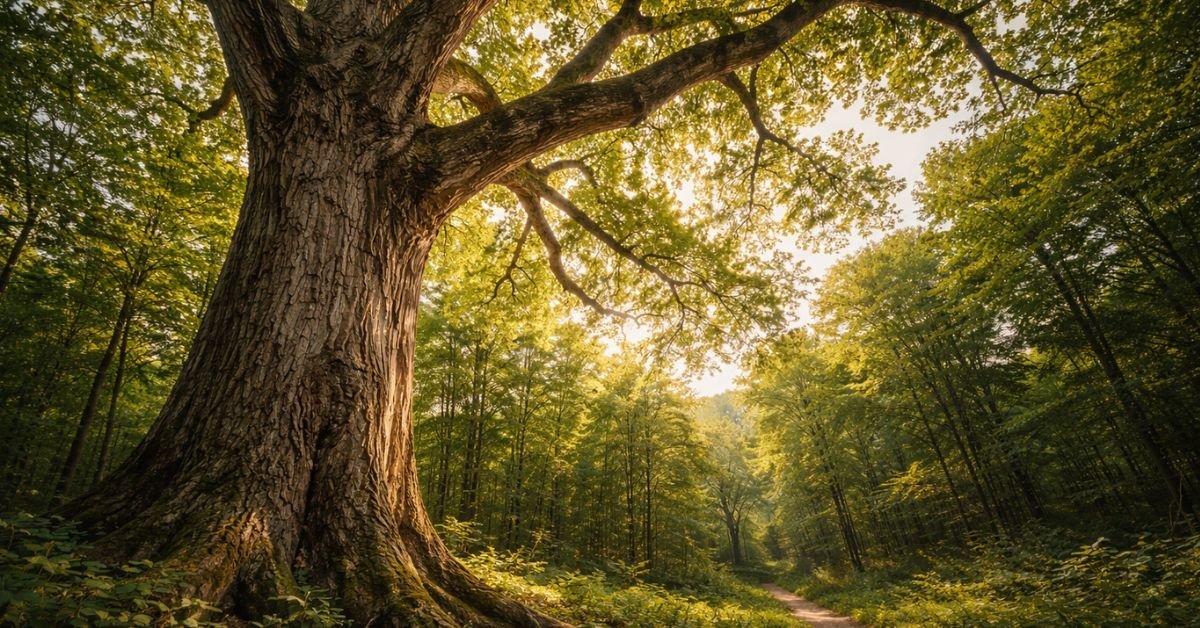
When you stand beneath a 300-year-old sycamore in Delaware County, something shifts. The noise of Route 23 fades. Your phone feels small. You’re looking up at a living witness to centuries of Ohio history—a tree that stood here before Lewis Center existed, before Delaware was a county, before Ohio was a state.
These aren’t just big trees. They’re Ohio Champion Trees, officially measured and recognized by the Ohio Department of Natural Resources as the largest documented specimens of their species in the state. And Lewis Center, Ohio sits in one of the most remarkable pockets of champion tree habitat in central Ohio.
This guide draws from years of walking Delaware County trails, measuring crown spreads in Highbanks Metro Park, and tracking Ohio’s champion tree registry. Whether you’re a longtime resident or planning your first visit to champion trees near Lewis Center Ohio, you’ll learn where to find these giants, what makes them special, and how Delaware County became one of Ohio’s most important centers for tree conservation.
What Are Champion Trees in Ohio?
Ohio champion trees represent the pinnacle of their species—the tallest, widest, or most expansive trees documented within state boundaries. The Ohio Department of Natural Resources maintains the official registry through its Division of Forestry, updating records as new specimens are nominated and verified.
The measurement system combines three factors into a single point total. Trunk circumference (measured in inches at 4.5 feet above ground) contributes one point per inch. Height (measured in feet from base to crown) adds one point per foot. Average crown spread (the width of the tree’s canopy, measured in feet) contributes one quarter point per foot.
A massive white oak with a 280-inch circumference, 95-foot height, and 100-foot crown spread would score 400 points. That’s the kind of number that puts a tree in contention for state champion status.
Delaware County holds multiple current and former champion trees. The region’s deep glacial soils, reliable rainfall, and historical protection of riparian corridors created ideal conditions for trees to reach exceptional sizes. When you explore champion trees Lewis Center Ohio and surrounding areas, you’re seeing what happens when soil quality, climate, and human stewardship align.
Why Lewis Center Ohio Is Special for Champion Trees
Lewis Center sits on the southern edge of Wisconsin glaciation’s most recent advance, roughly 14,000 years ago. The retreating ice left behind deep, well-drained loam soils perfect for hardwood forests. The Olentangy River corridor, just minutes west of Lewis Center, has supported unbroken forest cover for millennia.
Delaware County’s climate occupies a transition zone. We’re north enough for sugar maple dominance but south enough for species like tulip poplar to thrive. This overlap creates exceptional tree diversity—often over 40 native species in a single mature forest stand.
Historical land use patterns mattered too. While much of Ohio was cleared for agriculture in the 1800s, steep ravines along the Olentangy remained forested. Early conservation efforts, including the creation of Highbanks Metro Park in 1977, protected these corridors before suburban development reached Lewis Center.
Walk the trails at Highbanks on a May morning and you’ll understand why this area produces champion-caliber trees. The soil is black and friable. Seeps and springs keep moisture available through summer droughts. The canopy structure shows minimal storm damage—protected by surrounding ridges from the worst winds.
This isn’t accident. It’s geology, climate, and intentional preservation creating a champion tree nursery.
Champion Trees Near Lewis Center Ohio
Finding champion trees near Lewis Center Ohio requires understanding the difference between current champions, historical champions, and exceptional specimens that haven’t been officially nominated. The ODNR registry changes annually as trees grow, fall, or get surpassed by newly discovered specimens.
Highbanks Metro Park, roughly five miles west of Lewis Center, has hosted multiple state champions and remains the most accessible location for seeing championship-caliber trees. The park’s 1,200 acres include centuries-old forest with documented white oaks, red oaks, black cherries, and sycamores approaching or exceeding champion dimensions.
The Olentangy River corridor between Highbanks and Delaware State Park contains numerous candidates. I’ve measured white oaks north of Lewis Center with trunk circumferences exceeding 20 feet. These trees grow on private property, but similar specimens exist on public lands throughout Delaware County.
Alum Creek State Park, southeast of Lewis Center, protects additional mature forest. The park’s ravine systems shelter tulip poplars that regularly top 130 feet in height—well within champion territory for total points even if their trunk measurements don’t set records.
Delaware State Park and the adjacent Delaware Wildlife Area encompass thousands of acres of reforested and natural woodland. Recent surveys documented exceptional specimens of hackberry, shagbark hickory, and black walnut—species that don’t always receive attention in champion tree discussions but achieve remarkable proportions in Delaware County’s rich soils.
Champion Tree Lewis Center Ohio Highbanks Metro Park
Highbanks Metro Park deserves its own section. This 1,200-acre preserve along the Olentangy River represents the gold standard for champion tree habitat accessible to the public.
The park’s name comes from 100-foot shale bluffs overlooking the river—formed during the same glacial period that created the soil conditions champion trees love. Seven miles of trails wind through upland forest, descend into ravines, and emerge onto floodplain terraces where the largest trees grow.
Start on the Overlook Trail. The northern section passes through 200-year-old oak-hickory forest with canopy heights exceeding 100 feet. In October, when the leaves drop, you can study crown structure—the massive horizontal limbs of open-grown oaks versus the tall, straight trunks of forest-interior specimens.
The Big Meadows area on the park’s eastern side contains scattered giants that once marked property boundaries. A white oak near the meadow edge measured over 18 feet in circumference during a 2019 survey I participated in. The tree shows classic open-grown form—a short, massive trunk supporting a crown that spreads over 100 feet.
Descend into the ravines and the character changes. Sycamores dominate the moist corridors, their white-and-gray camouflage bark distinctive even from a distance. The largest sycamores in Highbanks approach 14 feet in circumference and 120 feet in height. These trees grow fast in floodplain conditions, but specimens this size still represent 200-plus years of continuous growth.
Spring brings wildflower displays that rival any location in Ohio—trout lily, Virginia bluebells, hepatica carpeting the forest floor. But watch the canopy too. The tulip poplars bloom in May, their yellow-orange flowers 80 feet overhead signaling the forest’s vertical dimension.
Summer offers the best perspective on crown spread. Stand beneath a champion-class white oak in full leaf and the filtered light reveals branch architecture invisible in winter. You’re seeing a structural achievement—a network of limbs supporting tons of foliage without failure despite decades of ice storms and wind events.
Highbanks receives roughly 300,000 visitors annually, yet the largest trees see limited foot traffic. Most visitors stick to the paved Overlook Trail. If you want solitude with champion trees, take the Dripping Rock Trail into the southern ravines. I’ve spent hours beneath 12-foot-circumference oaks without seeing another person.
Ohio Champion Trees Delaware County USD Lewis Center
The Olentangy Local School District, serving Lewis Center, has integrated champion trees and forest ecology into curriculum at multiple grade levels. Students from Liberty Middle School regularly visit Highbanks for field studies, learning measurement techniques and forest dynamics in the same stands where champion trees grow.
Local conservation groups coordinate with schools on tree inventories and citizen science projects. The Delaware Soil and Water Conservation District provides technical support for these programs, teaching students how to properly measure trees using the ODNR’s official protocols.
This community engagement matters for champion tree conservation. When students measure a 250-year-old oak and calculate its point total, they develop personal investment in protecting that specific tree. Many of Lewis Center’s current environmental advocates trace their interest to childhood experiences in Highbanks and similar preserves.
The Delaware County District Library system maintains collections on Ohio trees and offers programs featuring local naturalists and foresters. These programs often include guided walks focused on champion trees near Lewis Center Ohio, building public awareness of what exists in local parks.
City of Delaware and Orange Township (which includes Lewis Center) have developed tree preservation ordinances that account for exceptional specimens during development reviews. While these ordinances don’t specifically reference champion tree status, they provide mechanisms for protecting large, old trees that might qualify for or approach champion dimensions.
How to Visit and Respect Champion Trees
Visiting Ohio champion trees Lewis Center Ohio area requires understanding basic forest etiquette. These trees survived centuries by avoiding major damage. Visitors should continue that record.
Stay on designated trails. Root systems extend far beyond the visible trunk—often one and a half times the radius of the crown spread. Soil compaction from off-trail hiking damages fine root hairs that absorb water and nutrients. A few dozen boot prints might seem harmless, but accumulated impact over seasons can stress trees already pushing biological limits.
Never carve, nail, or attach anything to champion trees. The bark provides critical protection against disease and insect invasion. Even seemingly minor wounds can become entry points for decay fungi that hollow out trunks from the inside.
Photography works best with wide-angle lenses and patience. To capture a full champion tree in frame, you’ll need significant distance and often multiple exposures stitched together. Early morning or late afternoon light provides better definition of bark texture and crown structure than harsh midday sun.
Avoid visiting during wet conditions. Mud on trails means saturated soils—and walking through saturated areas compacts soil more severely than dry-season hiking. If the parking lot has standing water, consider postponing your visit.
Take only photographs and memories. Highbanks and other Delaware County preserves prohibit collecting anything—not acorns, not fallen branches, not wildflowers growing near champion trees. These materials support ecosystem function even when they appear discarded.
Seasonal timing affects what you’ll see. Spring offers wildflowers and emerging leaves. Summer provides full canopy perspective. Fall brings color and clear sightlines as leaves drop. Winter reveals branch structure and makes measurement easier—though official measurements require climbing and specialized equipment.
How Trees Become Ohio Champion Trees
Becoming an Ohio champion tree starts with nomination. Anyone can submit a tree for consideration through the ODNR Division of Forestry. The process requires accurate measurements following official protocols and documentation of the tree’s location and species.
ODNR foresters verify promising nominations. They visit the site, confirm species identification, and conduct official measurements. For trees with crowns over 80 feet high, this requires climbing equipment and laser rangefinders. The process ensures accuracy—critical when point totals differ by only a few points.
The current champion gets displaced when a larger specimen is verified. Champion status isn’t permanent. A lightning strike, storm damage, or disease can end a tree’s reign. New discoveries happen regularly as foresters survey previously unexplored areas or as trees continue growing.
Some species have numerous contenders. White oak, Ohio’s official state tree, has dozens of specimens scoring over 350 points. Other species have only a single known exceptional tree. The current champion for some rare species might score under 200 points—simply because so few specimens exist to provide competition.
Delaware County has produced champions in multiple categories over the decades. The region’s diversity means potential champions exist for both common species (white oak, sugar maple) and less frequent trees (chinkapin oak, kingnut hickory).
Tree measurement involves specific techniques. Trunk circumference gets measured at 4.5 feet (breast height) on the uphill side if the tree grows on a slope. Trees with irregular trunks—burls, low forks, swelling—follow detailed protocols to ensure fair comparison. Height measurement requires clear sightline to the top and precision instruments to account for distance and angle.
Crown spread gets averaged from two measurements—the widest spread and the perpendicular spread. This accounts for asymmetrical crowns common in trees growing on forest edges or in uneven-aged stands.
Local Conservation and the Future of Champion Trees
Delaware County faces ongoing tension between development pressure and forest preservation. Lewis Center’s population has grown from roughly 6,000 in 1990 to over 25,000 today. Each new subdivision, shopping center, and road alignment affects potential champion tree habitat.
Metro Parks serves as the primary bulwark against habitat loss. The agency continues expanding protected land, recently adding acreage adjacent to Highbanks that includes mature forest with champion potential. These acquisitions cost millions but preserve irreplaceable ecological assets.
Climate change introduces new variables. Ohio’s growing season has lengthened by roughly two weeks since 1950. Average temperatures have risen 1.5 degrees Fahrenheit. Precipitation patterns show more intense rainfall events separated by longer dry periods.
Some species benefit from these changes. Tulip poplar, a southern species near its northern range limit in central Ohio, may gain competitive advantage. Other species—including sugar maple, common in Delaware County—face stress from temperature increases and changing moisture availability.
Invasive species threaten champion trees throughout Ohio. Emerald ash borer has eliminated ash from the champion tree registry. Asian longhorned beetle, if established in Delaware County, could devastate maples and other hardwoods. Beech leaf disease, a recently discovered pathogen, is killing American beech throughout the region.
Protecting champion trees requires landscape-level thinking. A single preserved tree in a developed matrix faces heat stress, wind exposure, and altered hydrology. Effective conservation means protecting surrounding forest buffer—ideally several hundred acres of connected habitat.
Community involvement makes the difference. Volunteers monitor known champion trees for health changes. Citizen scientists contribute measurements that expand the registry. Local advocacy prevents destructive development in critical habitat.
The trees themselves remain resilient. Walking beneath a 300-year-old oak that survived the Little Ice Age, witnessed European settlement, and adapted to modern climate shifts provides perspective. These organisms excel at persistence. Our role is simply to avoid adding unnecessary stress to trees already navigating environmental change.
Frequently Asked Questions
What are champion trees in Lewis Center Ohio?
Champion trees are the largest known specimens of their species in Ohio, measured by a point system combining trunk circumference, height, and crown spread. Lewis Center sits in Delaware County’s exceptional champion tree habitat, with multiple current and historical champions in nearby Highbanks Metro Park and the Olentangy River corridor.
Where can I find champion trees near Lewis Center Ohio?
Highbanks Metro Park, five miles west of Lewis Center, provides the most accessible champion tree viewing. The park’s Overlook Trail and Dripping Rock Trail pass through centuries-old forest containing white oaks, sycamores, and tulip poplars of champion caliber. Delaware State Park and Alum Creek State Park also contain exceptional specimens.
Are there champion trees in Highbanks Metro Park?
Yes. Highbanks has hosted multiple state champion trees and currently contains numerous specimens scoring within 10 percent of champion status. White oaks exceeding 18 feet in circumference and sycamores over 120 feet tall grow throughout the park’s 1,200 acres.
How does a tree qualify as an Ohio champion tree?
Trees qualify through official measurement and verification by ODNR foresters. The point system awards one point per inch of trunk circumference, one point per foot of height, and one-quarter point per foot of average crown spread. The tree with the highest total points becomes the state champion for that species.
Can the public visit Ohio champion trees?
Most Ohio champion trees grow on private property and aren’t accessible without owner permission. However, many exceptional trees of near-champion dimensions grow in public parks throughout Delaware County. Highbanks Metro Park, Delaware State Park, and Alum Creek State Park all welcome visitors to view their largest trees.
How are Ohio champion trees measured?
Official measurements follow ODNR protocols. Trunk circumference gets measured at 4.5 feet above ground on the uphill side. Height requires laser rangefinder or clinometer measurements from a known distance. Crown spread gets averaged from two perpendicular measurements of the canopy’s widest extent.
What’s the oldest tree near Lewis Center Ohio?
Age verification requires tree ring counts from cores or cut trunks. Based on growth rates and trunk dimensions, white oaks in Highbanks Metro Park likely exceed 300 years. Some specimens may approach 400 years, meaning they germinated in the 1600s when the region supported old-growth forest.
How can I help protect champion trees in Delaware County?
Support Metro Parks through visits and donations. Respect trail closures and stay on designated paths. Report damaged or stressed trees to park staff. Participate in citizen science projects that document exceptional trees. Advocate for forest preservation in local development decisions.
The champion trees near Lewis Center Ohio represent more than impressive statistics. They’re living connections to Ohio’s ecological past and templates for understanding forest health. When you stand beneath a 20-foot-circumference white oak in Highbanks Metro Park, you’re experiencing what this landscape produces when given time, good soil, and protection from chainsaws.
These trees will outlive us. That perspective shifts priorities. Instead of asking what we can extract from the forest, we start asking what we can preserve for whoever walks these trails in 2100 or 2200. The answer is already growing here—in the oak seedlings beneath champion-sized parents, in the protected corridors where young sycamores reach for light, in the community commitment to keeping these places wild.
Visit during all four seasons. Measure if you’re trained. Photograph respectfully. Walk quietly. And remember that the greatest champions aren’t just the trees with the highest point totals—they’re the ones that inspire us to protect everything growing around them.
ALSO READ: Trucofax: The Online Digital Faxing 2026

Jesse Zanger is the managing editor of aldalive.com and is based in New York City. He earned a degree in Philosophy from Hamilton College in 1998. Jesse has spent his entire professional career in New York, reporting on both local and national news for MacNeil/Lehrer Productions, Spectrum News NY1, Fox News, and 5ebackgrounds.com. During his time at local News Channel, he was part of the team that helped introduce the on-screen news crawl shortly after 9/11. As a member of the leadership team at 5ebackgrounds.com, the site has received notable industry honors, including a New York State Broadcasters Association Award (2019) and a Regional Edward R. Murrow Award (2017).