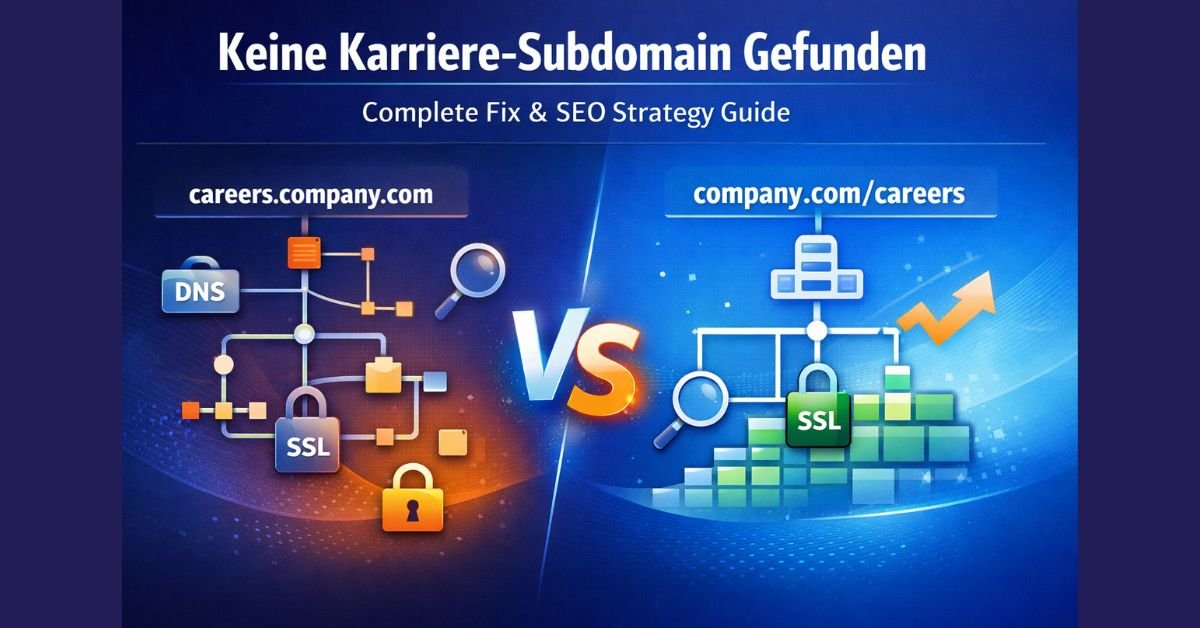
If you’ve encountered the message “keine karriere-subdomain gefunden” (translated: “no career subdomain found”) from an SEO audit tool, HR platform, or applicant tracking system, you’re not alone. This automated notification appears when a website analysis tool cannot locate a dedicated careers subdomain on your site. While it’s not a critical error that breaks your website, understanding what it means and how to address it strategically can significantly impact your recruitment success and SEO performance.
This comprehensive guide covers everything you need to know: what the message means, why it appears, how to fix it, and most importantly, how to make the right strategic decision for your business.
What Does “Keine Karriere-Subdomain Gefunden” Mean?
Direct Translation and Context
“Keine karriere-subdomain gefunden” translates to “no career subdomain found” in English. This message typically appears when automated systems such as SEO audit tools, HR software platforms, or applicant tracking systems (ATS) scan your website looking for a dedicated careers section structured as a subdomain (for example, careers.yourcompany.com or karriere.yourcompany.de).
Common triggers include SEO crawlers, recruitment technology platforms, and website analysis tools that expect to find job listings and career information on a separate subdomain rather than in a subfolder or on an external domain.
Is This a Critical Error?
No, this is a structural notification, not a technical failure. It’s important to understand that this message does not indicate your website is broken or malfunctioning. Unlike genuine errors such as 404 pages or DNS failures that prevent access to your content, this notification simply means the scanning tool didn’t find careers content structured in the specific way it was looking for.
Your careers page may exist and function perfectly well in a different structural format, such as a subfolder (yourcompany.com/careers) or on a third-party ATS domain. The message is an observation about your site architecture, not a malfunction.
Why Does This Message Appear? Common Causes
Technical Reasons (Most Common Triggers)
Subdomain Was Never Configured The most straightforward reason is that you simply never set up a careers subdomain. There are no DNS entries (A, AAAA, or CNAME records) pointing to karriere.yourdomain.com or careers.yourdomain.com.
Incorrect or Inactive DNS Configuration Even if you intended to create a subdomain, improper DNS settings can make it invisible to scanning tools. This includes misconfigured A records, CNAME records pointing to non-existent destinations, or DNS propagation delays.
Missing or Invalid SSL Certificate Modern browsers and tools require HTTPS connections. If your subdomain lacks a valid SSL security certificate, it may be inaccessible to automated scanners, triggering this message.
Structural and Content-Related Reasons
You Use a Subfolder Structure You may have deliberately chosen to place your careers content at yourcompany.com/careers rather than careers.yourcompany.com. This is a valid and often superior choice, but tools specifically searching for subdomains won’t find it.
Career Content is Hosted on External ATS Platform Many companies use third-party applicant tracking systems (like Workday, Personio, Greenhouse, or Lever) that host job listings on their own domains (for example, yourcompany.workday.com). In these cases, there may be no careers subdomain on your primary domain at all.
Old, Non-Redirected Links If you previously had a careers subdomain but migrated content elsewhere without setting up proper 301 redirects, scanning tools may still attempt to access the old location and report it as missing.
Subdomain vs. Subfolder: The Strategic SEO Decision
This is where the message becomes an opportunity rather than just a technical notification. Choosing between a subdomain and subfolder structure for your careers content is one of the most important SEO and user experience decisions you’ll make for your recruitment efforts.
What’s the Difference?
| Aspect | Subdomain (careers.company.com) | Subfolder (company.com/careers) |
|---|---|---|
| SEO Authority | Treated initially as a separate entity; requires its own link building | Inherits and consolidates authority from main domain |
| DNS Setup | Requires separate DNS records and SSL certificate | Uses existing domain infrastructure |
| Maintenance | Independent configuration and updates | Integrated with main site management |
| Analytics Tracking | May require separate tracking setup | Seamlessly integrated with main site analytics |
| Internal Linking | More complex cross-domain linking | Simple, natural internal link flow |
| Brand Perception | Can emphasize careers as separate, major initiative | Presents unified company presence |
Decision Matrix: What’s the Best Choice for You?
Choose a Subfolder (company.com/careers) if:
- SEO performance is a priority and you want to maximize your main domain’s authority
- You prefer simple, unified site management and maintenance
- You want seamless analytics tracking and internal linking
- Your careers content is closely integrated with your main brand messaging
- You’re a small to medium-sized company without complex technical infrastructure needs
Choose a Subdomain (careers.company.com) if:
- You use an external ATS that requires CNAME configuration to a third-party hosted platform
- You’re a large, global corporation with separate technical teams managing recruitment infrastructure
- You need to isolate careers content on different servers or content management systems
- Compliance or security requirements mandate separation of applicant data systems
- You want to create a distinctly branded careers experience independent of the main site
Third Option: External ATS Domain Some companies use their ATS provider’s domain entirely (yourcompany.atsplatform.com), accepting the trade-off of losing direct SEO benefits for operational convenience.
SEO Impact in Detail
Subfolder Advantages: Consolidates domain authority, making your entire site stronger in search rankings. Internal links from your high-authority homepage and other pages directly boost your careers content. Simpler for search engines to crawl and understand your site structure. Better for passing PageRank and building topical authority around employment-related queries.
Subdomain Considerations: Search engines initially treat subdomains somewhat separately from the main domain, requiring dedicated effort to build backlinks and authority. However, modern search engines are increasingly sophisticated at understanding subdomain relationships. The separation can be useful for very large sites but adds complexity for most organizations.
Step-by-Step Guide: How to Address the Issue
Step 1: Analyze Your Current Structure
Before making changes, understand where your careers content currently lives. Manually check your website navigation, search your site for job postings, and use Google Search Console to see which URLs are indexed under your domain. Document whether you’re using a subfolder, subdomain, external ATS, or have no dedicated careers section at all.
Step 2: Set Up the Right Structure (DNS, Hosting, SSL)
If Creating a Subdomain: Work with your IT team or hosting provider to create the necessary DNS records. You’ll need either an A record pointing to your server’s IP address or a CNAME record pointing to your hosting platform. Crucially, obtain and install an SSL certificate for the subdomain to ensure HTTPS access. Most modern hosting providers can issue free SSL certificates through Let’s Encrypt.
If Using a Subfolder: Ensure your content management system properly routes the /careers path to the appropriate content. Verify that your site’s navigation clearly links to this section from your main menu and footer.
If Integrating an External ATS: Configure CNAME records to point a subdomain (like jobs.yourcompany.com) to your ATS provider’s servers. Most professional ATS platforms provide detailed setup instructions. Ensure you can customize branding to maintain a consistent candidate experience.
Create clear, prominent navigation links to your careers section in your website header and footer. If you’re migrating from an old structure, implement 301 permanent redirects from previous URLs to your new careers location. Ensure your site search functionality can find and display careers content. Build internal links from relevant blog posts, about pages, and press releases to your careers section.
Step 4: Optimize for Search Engines and AI (SEO & GAIO)
Implement Structured Data: Add JobPosting schema markup to individual job listings. This enables your positions to appear in Google for Jobs and other specialized search features. Use the structured data testing tool to validate your implementation.
Generative AI Optimization (GAIO): As AI tools like ChatGPT increasingly surface career information, structure your content to be AI-friendly. Create clear FAQ sections that directly answer common candidate questions. Use concise bullet points highlighting key benefits and requirements. Write in natural language that AI can easily parse and summarize. Include comprehensive information about company culture, team structure, and growth opportunities.
Step 5: Test and Monitor
Run your SEO audit tool again to verify the message no longer appears. Use Google Search Console to confirm your careers pages are being crawled and indexed properly. Set up conversion tracking for job applications. Monitor organic search traffic to careers content and track which search queries drive candidates to your site. Regularly check that SSL certificates remain valid and DNS settings are functioning correctly.
Best Practices for a High-Converting Careers Page
Technical Performance
Ensure mobile-first design, as many job seekers browse opportunities on smartphones. Optimize loading speed to meet Core Web Vitals standards. Use clean, readable URLs for individual job postings. Implement accessible design following WCAG guidelines so all candidates can navigate your content.
Content and Employer Branding
Create compelling content that goes beyond just job descriptions. Showcase your team through employee testimonials and team photos. Highlight your company culture, values, and mission. Clearly communicate benefits, growth opportunities, and what makes your organization unique. Regularly update content by removing filled positions and adding new opportunities promptly.
Advanced SEO and AI Optimization
Build backlinks to your careers section from relevant sources such as industry associations, universities, and professional networks. Encourage social sharing of job postings by making share buttons prominent. Prepare for zero-click search by providing direct, comprehensive answers to common candidate questions directly on the page. Optimize meta descriptions for job listing pages to improve click-through rates from search results.
Frequently Asked Questions
Do I Need to Have a Career Subdomain?
No, a subdomain is not required. Many successful companies use subfolders (company.com/careers) or rely entirely on external ATS platforms. The choice depends on your technical setup, SEO priorities, and operational needs. The key is having a well-optimized, accessible careers section somewhere, not necessarily on a subdomain.
Does “Keine Karriere-Subdomain Gefunden” Hurt My Google Rankings?
The message itself doesn’t directly harm rankings. However, if your careers content is poorly structured, difficult to find, or lacks proper optimization, you’ll lose valuable organic traffic from job seekers. The underlying structural issues indicated by the message could impact SEO performance, but the notification is just the symptom, not the cause.
I Use an ATS (Like Personio, Workday, Greenhouse). What Does This Message Mean for Me?
Most ATS platforms host your careers page on their infrastructure. You typically integrate this with your domain using a CNAME record (such as jobs.yourcompany.com pointing to your ATS provider’s servers). Tools may still show this message because they’re looking for a subdomain you directly control. This is normal and not necessarily problematic, though you should ensure the integration is properly configured and branded.
How Does This Choice Affect My Paid Job Advertisements?
A secure (HTTPS), well-linked, fast-loading destination page improves quality scores for paid campaigns on platforms like Google Ads and LinkedIn. Better landing page experience leads to lower cost-per-click and higher conversion rates from applicants. Regardless of whether you choose a subdomain or subfolder, ensure your landing page provides an excellent user experience.
Are There Legal Considerations When Choosing Domain Structure?
Primarily, ensure you have rights to any domain names you register. Check trademark databases to avoid conflicts if creating a distinct branded subdomain. For companies operating in multiple countries, consider regional domain requirements and data protection regulations (like GDPR) that may influence where and how you host applicant data. Consult legal counsel if you have specific concerns about employment data handling.
Conclusion
“Keine karriere-subdomain gefunden” is an informational message, not a crisis. It’s an opportunity to evaluate your careers content strategy and ensure you’re making the best structural decision for your business goals. For most organizations, a subfolder approach offers the best balance of SEO performance, technical simplicity, and user experience. However, companies with complex technical requirements or using enterprise ATS platforms may benefit from subdomain structures.
The most important factors are ensuring your careers content is easily discoverable, properly optimized for search engines and AI tools, secure with valid HTTPS, and provides an excellent experience for potential applicants. Whether that content lives on a subdomain, in a subfolder, or on an integrated ATS platform matters less than how well you execute the fundamentals.
Last updated: January 2026