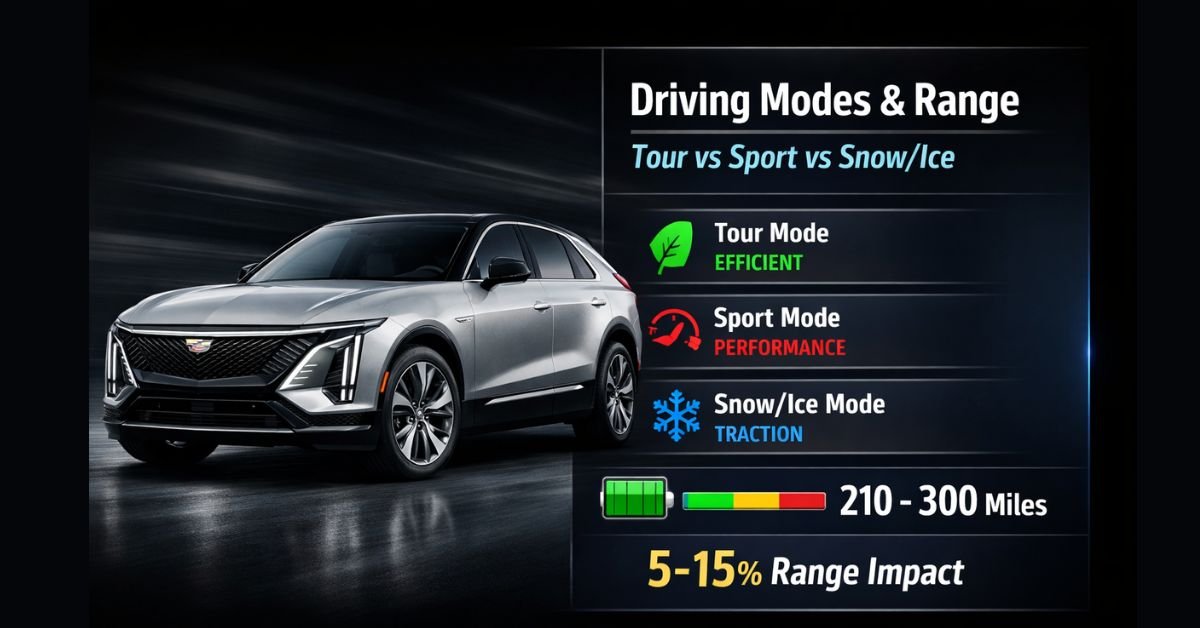
Yes, Cadillac Lyriq driving modes significantly affect range and battery usage. While the battery capacity remains constant at 102 kWh regardless of which mode you select, different modes alter how efficiently the vehicle consumes that stored energy. Tour Mode prioritizes maximum range through optimized throttle response and aggressive regenerative braking, while Sport Mode sacrifices 5-15% of range for enhanced performance. Understanding how each mode impacts energy consumption per mile (measured in Wh/mi) is essential for maximizing your Lyriq’s real-world range.
How Driving Modes Influence EV Efficiency and Range
Driving modes in the Cadillac Lyriq don’t change your battery’s total energy storage—they modify how quickly that energy is consumed. Each mode adjusts several interconnected systems that directly impact efficiency:
Throttle mapping controls how aggressively the accelerator pedal responds to driver input. Sport Mode delivers immediate, sharp acceleration that draws more power from the battery, increasing energy consumption per mile. Tour Mode applies gentler throttle progression, encouraging smoother acceleration that conserves energy.
Regenerative braking strategy determines how much kinetic energy gets recaptured when you decelerate. Tour Mode employs strong regenerative braking that maximizes energy recapture, effectively extending range. Sport Mode reduces regenerative braking intensity to allow more coasting, which feels sportier but captures less energy.
Ancillary system adjustments affect climate control intensity, steering effort, and suspension firmness. These seemingly minor changes compound over longer drives. For instance, Sport Mode may run the climate system more aggressively to maintain cabin comfort during spirited driving, drawing additional power beyond what the drivetrain alone consumes.
The cumulative effect of these adjustments determines your vehicle’s efficiency rating in watt-hours per mile (Wh/mi). Lower Wh/mi numbers indicate better efficiency and longer range from the same battery capacity.
2026 Cadillac Lyriq: Battery and Powertrain Specifications
Understanding the baseline specifications helps contextualize how driving modes impact performance and efficiency:
| Configuration | Battery Capacity | Horsepower | Torque | EPA Range | 0-60 mph |
|---|---|---|---|---|---|
| RWD Single-Motor | 102 kWh | 340 HP | 325 lb-ft | Up to 314 miles | 5.7 seconds |
| AWD Dual-Motor | 102 kWh | 500 HP | 450 lb-ft | Up to 308 miles | 4.6 seconds |
| Lyriq-V | 102 kWh | 615 HP | 650 lb-ft | Est. 285 miles | 3.3 seconds |
All Lyriq variants share the same Ultium Platform and 102 kWh battery pack. The range differences between configurations result from the additional weight and power draw of dual-motor AWD systems, not battery capacity variations.
Detailed Analysis of Each Lyriq Driving Mode
Tour Mode: The Efficiency Benchmark
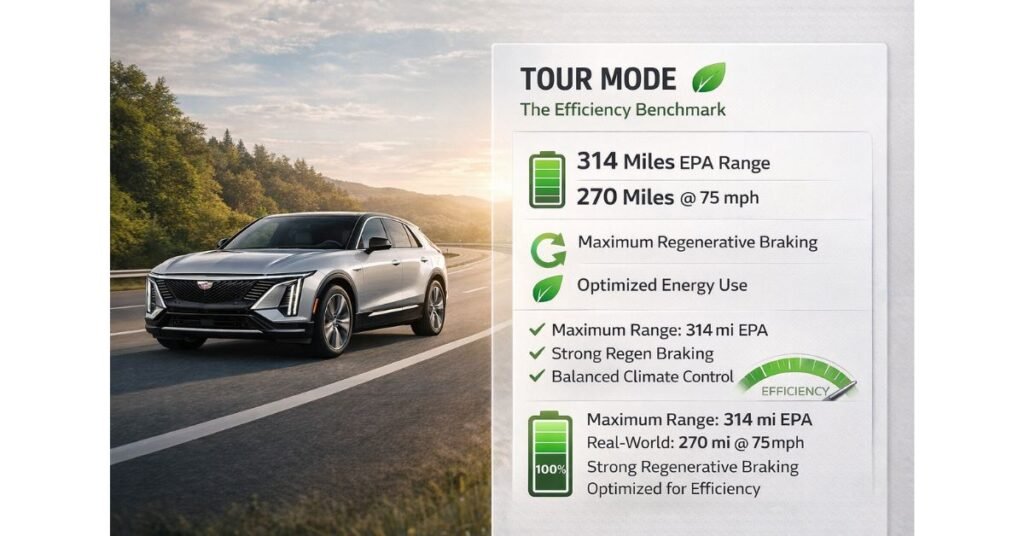
Tour Mode is engineered specifically for maximum range. This default setting balances performance with efficiency by prioritizing energy conservation across all vehicle systems. The calibration emphasizes smooth power delivery, strong regenerative braking, and optimized climate control.
In real-world testing, Tour Mode delivers results closest to EPA estimates. Car and Driver’s 75-mph highway range test achieved approximately 270 miles in the RWD Lyriq using Tour Mode—impressive considering highway driving typically reduces EV range compared to city driving. The strong regenerative braking in Tour Mode proves particularly beneficial in urban environments, where frequent deceleration allows substantial energy recapture.
Tour Mode serves as the baseline for EPA range ratings. If your goal is to minimize charging stops on road trips or maximize daily range, Tour Mode should be your default selection. The efficiency gains come without compromising safety or essential comfort features.
Sport Mode: Performance at a Range Cost
Sport Mode transforms the Lyriq’s character but introduces a measurable range penalty of 5-15%. This mode sharpens throttle response dramatically, making the accelerator pedal more sensitive to inputs. The instant power delivery feels exhilarating but consumes energy at a higher rate.
Regenerative braking is intentionally reduced in Sport Mode to allow more coasting when you lift off the accelerator. While this creates a more traditional driving feel that enthusiasts appreciate, it means less kinetic energy gets recaptured and returned to the battery. Over the course of a drive with frequent speed changes, this lost recapture opportunity compounds into noticeable range reduction.
For a Lyriq RWD with 314 miles of EPA range, Sport Mode could reduce real-world range to approximately 265-298 miles depending on driving conditions. The penalty increases with aggressive driving style—combining Sport Mode with rapid acceleration and high speeds can push energy consumption well above baseline Tour Mode efficiency. Highway driving in Sport Mode particularly impacts range due to increased aerodynamic drag at sustained higher speeds.
Snow/Ice Mode: Traction Over Optimal Efficiency
Snow/Ice Mode prioritizes safety and traction control over maximum efficiency. This mode makes critical adjustments for low-grip conditions: power delivery becomes more conservative to prevent wheel slip, traction control intervenes more readily, and regenerative braking is reduced to maintain vehicle stability during deceleration.
The reduction in regenerative braking prevents the jarring sensation of aggressive regen on slippery surfaces, which could destabilize the vehicle. However, this safety-focused calibration means less energy recapture during normal driving. The range impact from Snow/Ice Mode itself is relatively minor—perhaps 3-8% under dry conditions—but cold ambient temperatures that necessitate this mode create far more significant range reduction.
Winter driving conditions combine multiple range-reducing factors: cold batteries operate less efficiently, cabin heating draws substantial power, and snow or ice creates rolling resistance. Snow/Ice Mode’s contribution to reduced range is secondary to these environmental factors, but users should expect shorter range when this mode is necessary.
My Mode & V-Series Modes: Custom and Extreme Performance
My Mode allows drivers to create custom efficiency profiles by selecting individual settings for steering, suspension, throttle response, and regenerative braking. This flexibility means efficiency depends entirely on user choices. A driver could theoretically create a configuration even more efficient than Tour Mode by selecting maximum regenerative braking, gentle throttle response, and comfort suspension. Alternatively, selecting aggressive settings across all parameters could result in efficiency worse than Sport Mode.
Lyriq-V performance modes prioritize maximum capability over range considerations. Velocity Max mode unlocks the full 615 horsepower and 650 lb-ft of torque, enabling the 3.3-second 0-60 mph sprint. Competitive Mode adds launch control and track-focused stability calibration. These modes are engineered for peak performance driving where range takes a back seat to capability.
Expect Lyriq-V models to achieve significantly less than the estimated 285-mile EPA range when using performance modes aggressively. The combination of higher power output, reduced regenerative braking for performance feel, and aggressive driving style can reduce real-world range by 20-30% compared to Tour Mode efficiency.
Maximizing Your Lyriq’s Range: Beyond Driving Modes
Driving mode selection represents just one variable in the complex equation of EV range. Several additional strategies can substantially extend your Lyriq’s real-world range:
Cabin preconditioning while connected to charger allows you to heat or cool the interior using grid power rather than battery energy. The myCadillac app enables remote climate activation. Preconditioning can save 10-20 miles of range on extreme temperature days by reducing climate control demand once you begin driving.
One-Pedal Driving and Regen on Demand work synergistically with driving modes. Even in Sport Mode, engaging One-Pedal Driving maximizes energy recapture in city traffic. The Regen on Demand paddle provides manual control over regenerative intensity, allowing you to recapture energy aggressively when approaching stops regardless of your selected driving mode.
Maintaining proper tire pressure prevents increased rolling resistance. The Lyriq’s different wheel sizes (19″, 20″, or 22″ depending on trim) affect both aerodynamic drag and rolling resistance. Larger wheels with lower-profile tires typically reduce range by 2-5% compared to smaller wheel options. Check tire pressure monthly and maintain manufacturer specifications.
Moderating highway speed yields dramatic efficiency improvements. Energy consumption increases exponentially with speed due to aerodynamic drag. Reducing highway cruising speed from 75 mph to 65 mph can extend range by 15-25%. The Lyriq’s Energy Assist feature in the myCadillac app provides real-time efficiency coaching and trip planning that accounts for these variables.
Minimize aggressive acceleration and hard braking regardless of driving mode. Smooth, predictable driving style compounds the efficiency benefits of Tour Mode. Anticipating traffic flow and maintaining steady speeds reduces the number of acceleration events that draw peak power from the battery.
Frequently Asked Questions (FAQs)
Which Cadillac Lyriq driving mode provides the longest range?
Tour Mode delivers the longest range by optimizing throttle response, maximizing regenerative braking, and balancing all vehicle systems for efficiency. It’s the mode used for EPA range testing and should be your default selection for maximum range.
How much range do I lose using Sport Mode?
Sport Mode typically reduces range by 5-15% compared to Tour Mode. For a Lyriq RWD with 314 miles of EPA range, expect approximately 265-298 miles in Sport Mode. The exact penalty depends on driving style—aggressive acceleration and high speeds increase the efficiency cost.
Does using Snow/Ice mode drain the battery faster?
Snow/Ice Mode has a modest direct impact on efficiency (3-8% reduction) due to reduced regenerative braking and conservative power delivery. However, the cold weather conditions that necessitate this mode create far more significant range reduction through battery temperature effects and cabin heating demand.
Is it bad for the battery to always drive in Sport Mode?
No. Sport Mode affects how energy is consumed, not battery longevity or health. The Lyriq’s battery management system protects the battery regardless of driving mode. You can freely use Sport Mode without concern for long-term battery degradation—the only consequence is reduced range per charge.
How does regenerative braking work with different driving modes?
Tour Mode employs the strongest regenerative braking, aggressively recapturing kinetic energy during deceleration. Sport Mode reduces regenerative braking intensity to allow more coasting, creating a sportier feel but capturing less energy. Snow/Ice Mode minimizes regen to maintain traction on slippery surfaces. My Mode allows custom regen calibration.
Can I exceed the EPA range estimate in my Lyriq?
Yes. EPA estimates represent mixed driving conditions at standardized speeds. Using Tour Mode exclusively, driving gently, maintaining moderate speeds (55-65 mph on highways), and taking advantage of regenerative braking in city driving can exceed EPA estimates by 10-20% under favorable conditions. Real-world range above 340 miles has been achieved in the RWD Lyriq with optimal driving technique and conditions.
Understanding how driving modes affect your Cadillac Lyriq’s energy consumption empowers you to make informed choices that balance performance desires with range requirements. While Tour Mode maximizes efficiency, the Lyriq’s 102 kWh battery provides sufficient capacity for occasional Sport Mode driving without range anxiety for most daily use cases.

Jesse Zanger is the managing editor of aldalive.com and is based in New York City. He earned a degree in Philosophy from Hamilton College in 1998. Jesse has spent his entire professional career in New York, reporting on both local and national news for MacNeil/Lehrer Productions, Spectrum News NY1, Fox News, and 5ebackgrounds.com. During his time at local News Channel, he was part of the team that helped introduce the on-screen news crawl shortly after 9/11. As a member of the leadership team at 5ebackgrounds.com, the site has received notable industry honors, including a New York State Broadcasters Association Award (2019) and a Regional Edward R. Murrow Award (2017).